What Actually Damages a Motorcycle Parked Outside (and What Doesn't)
The real threats to a parked motorcycle are UV, standing moisture and condensation, acidic bird droppings and sap, road salt, wind-blown grit and rodents. Cold air, a single rain shower and a layer of dirt do far less harm than most riders assume. The difference is time: a bike ridden in rain dries itself within minutes, while a bike parked in rain stays wet for days.
Is it bad to leave a motorcycle outside?
It depends entirely on how long it sits between rides, and almost not at all on whether the weather is bad.
A motorcycle is engineered to be rained on. It is not engineered to stay wet. When you ride in rain, airflow and engine heat drive water off the machine within minutes of arriving, the chain keeps its lubricant moving, and you are looking at the bike closely enough to notice a seized cable or a soft brake. Riding is a self-drying, self-inspecting activity.
A parked bike does none of that. Water sits in panel gaps, in switch bodies, on caliper faces, in the chain's roller gaps and on every fastener head. It sits there for the two weeks between rides, and nobody looks at it. That is the whole distinction, and it is why "my bike gets ridden in the rain all the time, so why would a cover matter?" is the wrong question.
So: a bike used every day and parked outside is in reasonable shape. A bike parked outside and ridden on alternate Sundays is on a slow clock. A bike parked outside and not touched for five months is where all the expensive stories come from.
What damages a motorcycle parked outside, ranked by repair cost?
Seven mechanisms, worst first. Worst means most expensive and least reversible, not most visible.
1. Standing moisture and condensation. Condensation happens when a surface falls below the dew point of the air around it, so water forms on the metal without any rain falling at all. A parked bike radiates heat to the night sky and can sit a couple of degrees colder than the surrounding air, which is why you find a soaking bike on a dry, clear morning. Surface rust on brake discs is cosmetic and wears off in the first few stops. Corrosion inside electrical connectors, caliper seals, wheel bearings and chain rollers is not cosmetic, does not wipe off, and is billed in labor hours.
2. Road salt and coastal air. Salt is hygroscopic: it pulls moisture out of humid air and keeps a surface wet at humidity levels where plain metal would stay dry. Chloride also accelerates the electrochemical reaction itself. Worse, it attacks the joints between dissimilar metals: a steel fastener in an aluminum case, wetted with salt solution, corrodes far faster than either metal alone. This is why a bike parked near the ocean or on a salted winter street ages faster than the same bike three hours inland.
3. UV, the underrated one. Ultraviolet breaks down the polymers in everything soft on the machine. Paint fades and its clearcoat goes chalky; unpainted black plastics turn gray and become brittle; headlight and instrument lenses haze; seat vinyl hardens, then splits at the stitch lines; rubber grips, gaiters and cable boots perish. It is cumulative, it is irreversible without refinishing or replacement, and it is invisible until the day it is very visible. UV does not care about the season: a bike parked in Arizona in July is taking more damage per week than a bike parked in Ohio in January.
4. Bird droppings and tree sap. Droppings are acidic and, on a hot day, the clearcoat softens enough that the dropping etches its own outline into the lacquer within a day or two. Sap bonds hard and then takes clearcoat with it when it is scraped. By the time you see the mark, it is usually in the paint rather than on it. This is the single strongest argument against parking under a tree, and it is a same-week problem, not a same-year one.
5. Rodents and insects. A parked motorcycle is a dry, sheltered cavity. Mice nest in airboxes, exhaust outlets, fairing voids and under seats, and chew wiring insulation because it is good nest material. Wasps build in exhaust tips and mirror stalks. This is how a storage mistake turns into an intermittent electrical fault you chase for a month.
6. Heat cycling. Every hot day and cold night expands and contracts everything on the bike by slightly different amounts. Over years this works fasteners loose, hardens rubber seals, and drives fuel vapor and moisture in and out through the tank breather. Slow, undramatic, and it is a large part of why a ten-year-old bike that lived outside feels tired next to one that lived in a garage.
7. Dust and grit. Completely harmless while it sits still. Abrasive the instant anything moves across it: a loose cover in wind, a dry cloth, your own hand wiping the tank. Nearly all "cover scratches" are grit plus movement, not fabric.
Damage matrix
| Damage type | What it attacks | Reversible? | Typical cost to fix | Does a cover help? |
|---|---|---|---|---|
| Condensation and standing water | Connectors, bearings, caliper seals, chain, fasteners | Partly: surface rust yes, internal corrosion no | Low to high, depending on where it got in | Partly, only if breathable and only if the bike went under dry |
| Road salt / coastal air | Same as above, faster; dissimilar-metal joints | No | Moderate to high | Yes, it blocks direct spray and airborne salt |
| UV | Paint, plastics, lenses, seat vinyl, rubber | No (refinish or replace) | Moderate (seat, plastics, respray) | Yes, this is what a cover does best |
| Bird droppings and sap | Clearcoat | No once etched | Moderate (paint correction or respray) | Yes, fully |
| Rodents | Wiring, airbox, exhaust, seat foam | No | Low to very high | No, a cover does nothing about this |
| Heat cycling | Seals, rubber, fasteners, fuel system | No | Diffuse; shows up as general age | Slightly, by moderating surface temperature swings |
| Dust and grit | Paint, when something moves across it | Yes, usually, with machine polish | Low | Yes if fitted, no if loose (a flapping cover causes it) |
What does not damage a motorcycle parked outside as much as people think?
Three things riders worry about that mostly do not matter:
Cold itself. Below-freezing air does very little to a motorcycle. Modern coolant handles it, fluids handle it, metal handles it. The one genuine cold-specific risk is a discharged lead-acid battery: fully charged electrolyte resists freezing far below anything you will encounter, but a flat battery's electrolyte is much closer to plain water and can freeze near 18°F (about -8°C), which splits the case. That is a discharge problem showing up as a cold problem. Keep it charged and cold is a non-event.
A single rain shower. A modern motorcycle is fully weatherproofed for use. Getting rained on for an afternoon and then drying out is what it was built for. The problem is never the rain event; it is the week of staying damp afterward.
Dirt, up to a point. A dirty bike is not a damaged bike. It is a bike you cannot inspect, and road film does hold moisture against metal, which is why washing before a long layup matters. But a dusty bike ridden weekly is in no danger. There is no need to feel guilty about it.
Being clear about what does not matter is the point of this section. If everything is a crisis, nothing gets prioritized.
How does outdoor damage change by climate?
The dominant threat is completely different depending on where you park, and the right response follows from that:
- Pacific Northwest and coastal British Columbia: persistent damp, mild temperatures, relatively low UV. Corrosion and mildew are the problem; a bike here can stay wet for weeks. Breathability of any cover matters more here than anywhere else in North America.
- Southwest (Arizona, Nevada, inland California, New Mexico): extreme UV and heat, very little moisture. Paint, plastics, seat vinyl and rubber age fastest here, and corrosion is barely an issue. Shade is worth more than waterproofing.
- Gulf Coast and Southeast: heat, high humidity, intense summer sun and salt air near the coast. The worst combination on the continent: UV degradation and corrosion running at the same time, plus a long insect and rodent season.
- Northeast and Midwest: freeze-thaw cycling and heavy road salt. Salt spray thrown up in winter is the defining issue, and it is why washing the underside before a layup matters more here than anywhere.
- Canadian prairies and eastern Canada: the longest sub-zero layup, heavy snow load on anything covered, and salted or brined roads. The season is long enough that a bike stored badly in October is genuinely damaged by April.
What does a motorcycle cover actually protect against?
An honest scorecard, because a cover is not a general-purpose shield.
It solves outright: UV on paint, plastics, lenses and seat; direct rain, snow and hail; bird droppings and tree sap; dust and airborne grit settling on the bike; and casual visual target selection by thieves, since a covered bike does not advertise its make, model or value.
It partly solves: condensation and ambient damp, but only if the cover is breathable, and only if the bike went underneath dry. A cover manages precipitation. It does not dehumidify the air.
It does not solve: ambient humidity, flooding, a determined thief with tools, rodents already inside the bike, or any damage caused by putting the cover on a wet or hot machine.
That middle category is where most cover disappointment comes from. If your bike is corroding under a cover, the fault is almost always one of three things: the material does not breathe, the bike was wet when it went under, or water is getting in at the bottom and cannot get out.
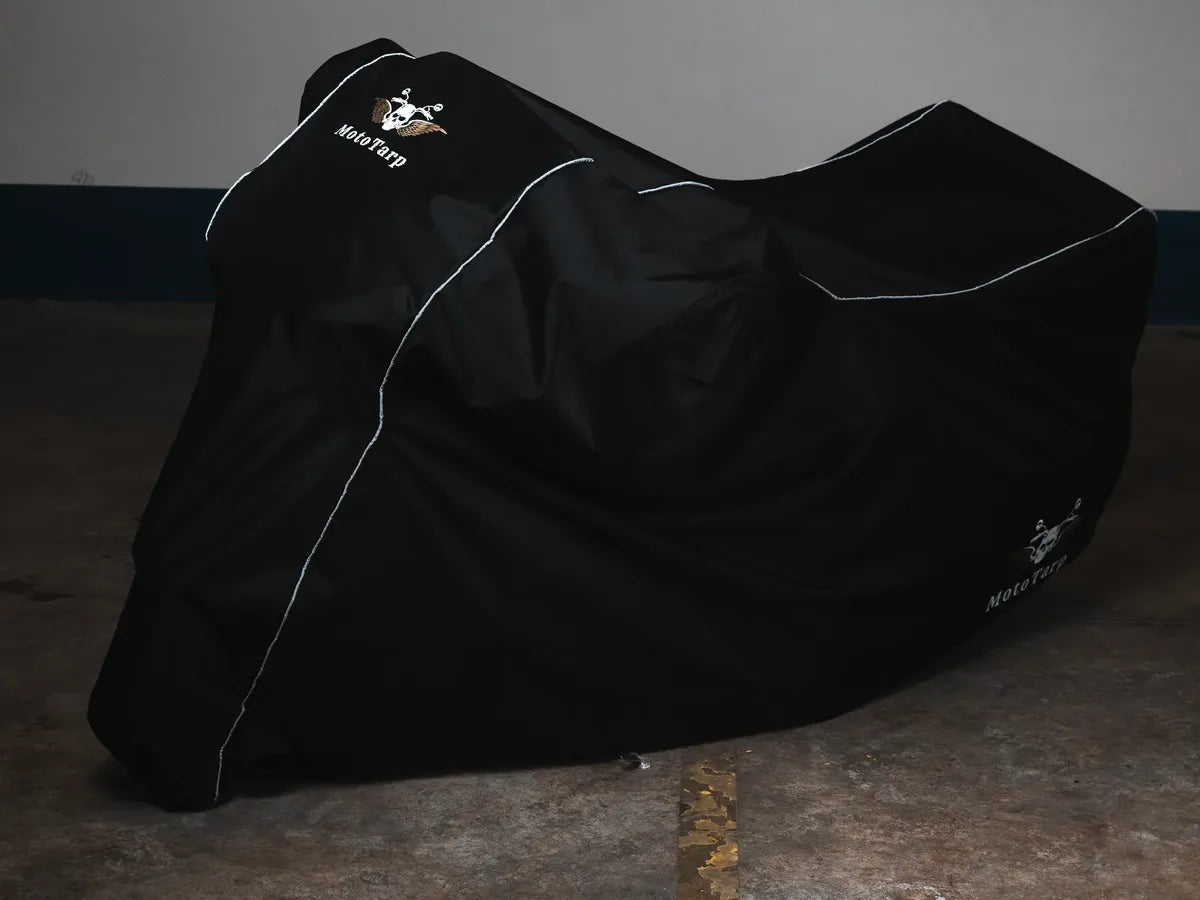
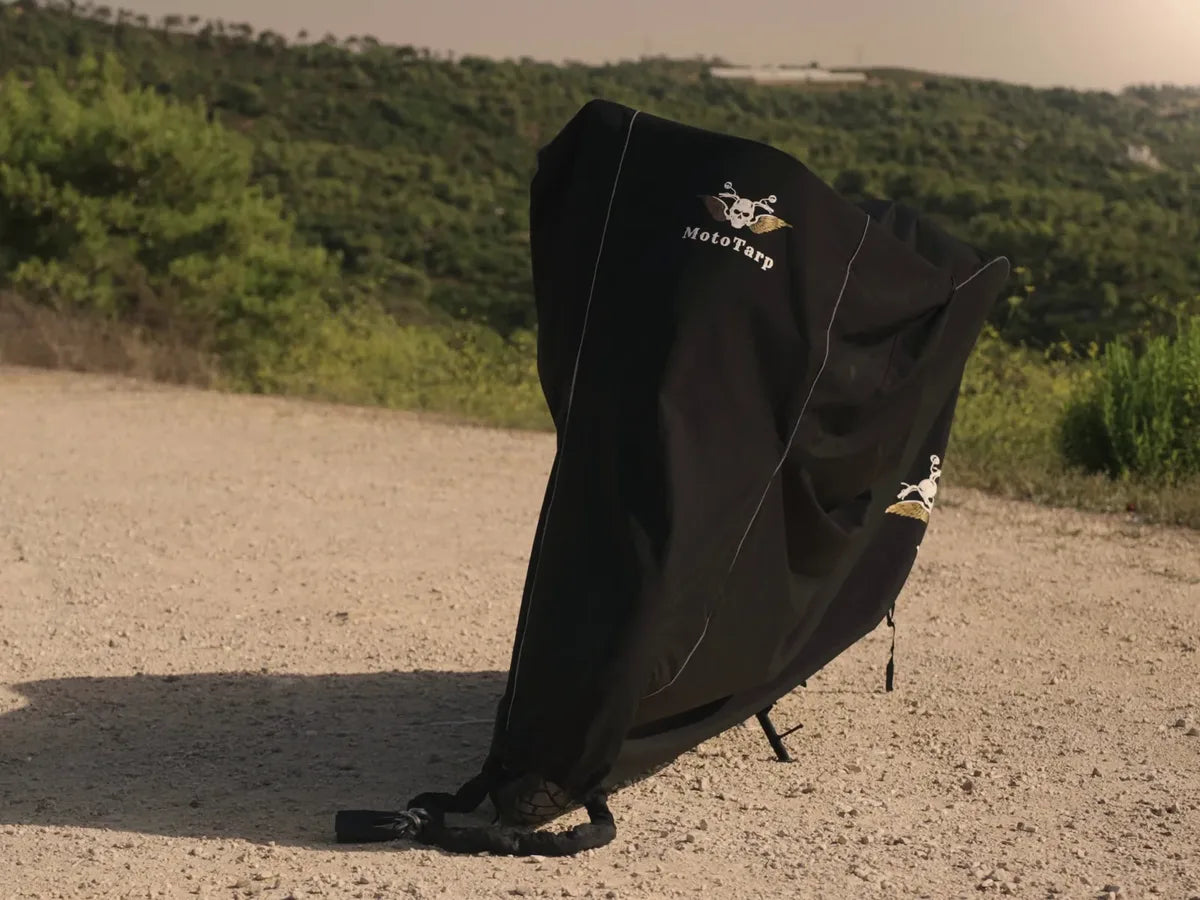
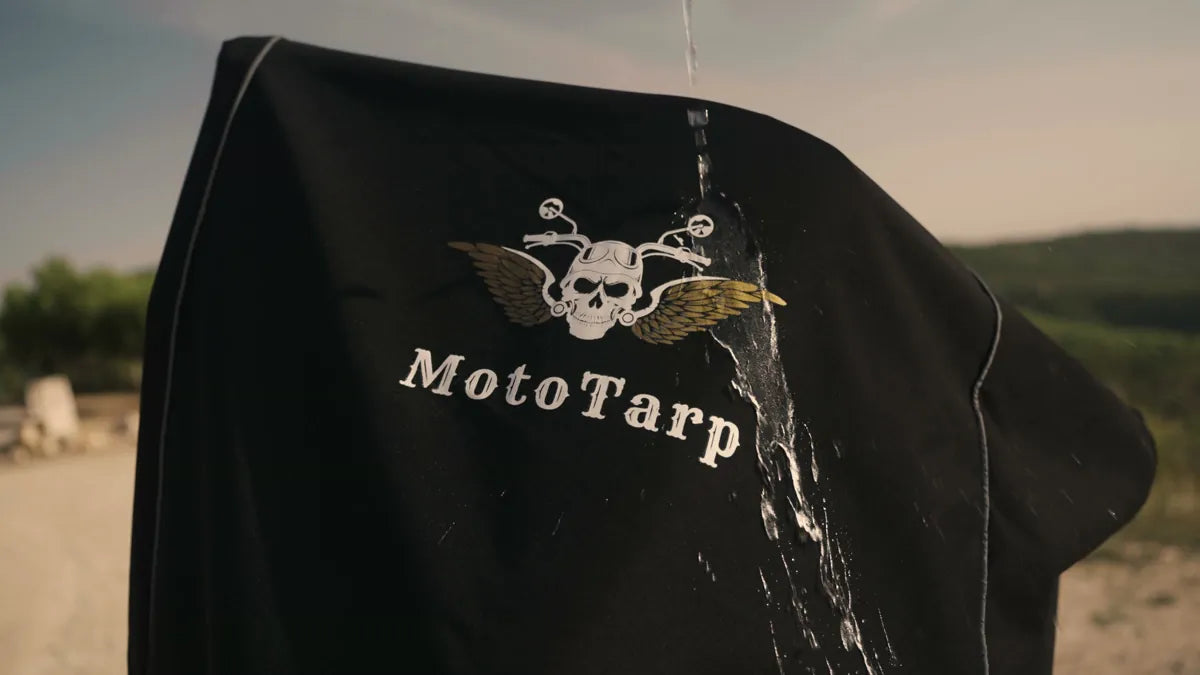
A cover built for outdoor use should therefore do several things at once: keep liquid water out, let vapor out, hold itself tight to the bike so it cannot flap, and tolerate a warm exhaust. When you compare covers, compare them on those points. For reference, the MotoTarp® Heavy-Duty Cover, in factory-spec terms, is 600D polyester fabric in matte black, 220 g/m² fabric weight, with a PVC coating on the inside, a splash-repellent coating on the outside, a 10,000 mm water-pressure rating, and heat-protection panels sewn in low on both sides.
When does a motorcycle cover make things worse?
Three ways, and all three are avoidable:
A non-breathable cover traps moisture. A household tarp or plastic sheet stops rain but also stops evaporation. Residual moisture from the bike, the ground and the air condenses on the inside of the sheet, drips back down, and repeats every day for months. This is worse than leaving the bike uncovered, because an uncovered bike at least dries in the wind. It is the most common way a cover causes damage rather than preventing it.
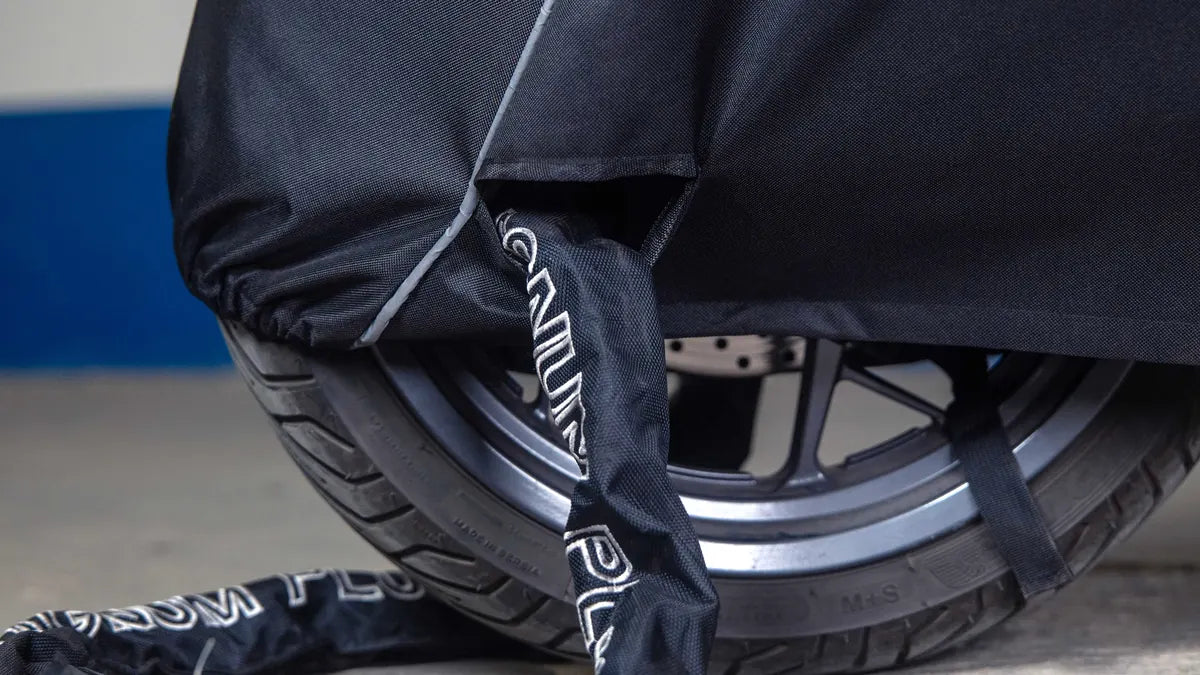
A loose cover abrades paint. Fine grit always sits between fabric and clearcoat. A cover that flaps in the wind moves that grit across the paint thousands of times a night, and the result looks exactly like a swirl-scratched respray. Straps, elastic hems and under-bike buckles exist to stop that, and a cover two sizes too large will scratch a bike regardless of what it is made of.
A cover over a hot exhaust melts or fuses. Fabric laid on hot headers scorches, sticks and ruins both the cover and, sometimes, the finish on the pipe. Wait twenty to thirty minutes after a ride, or use a cover with a heat-shield panel over the exhaust area.
Every one of these is a fitting-and-timing failure rather than a reason to skip covering the bike. But they are real, they are common, and any source that will not tell you about them is not worth trusting on the rest.
Quick answers
Is it bad to leave a motorcycle outside?
Not inherently. A bike ridden regularly and parked outside is fine. The damage comes from time spent standing wet, in UV, under trees or in salt. The longer the gaps between rides, the more the parking environment matters and the more a cover earns its place.
Does rain damage a motorcycle?
Riding in rain does not. A motorcycle is weatherproofed for use, and airflow and engine heat dry it within minutes. What causes damage is a parked bike staying wet for days, letting water work into connectors, bearings, caliper seals and chain rollers where it corrodes out of sight.
Does sun damage a motorcycle?
Yes, and it is the most underrated threat. UV fades and chalks paint, embrittles unpainted plastics, hazes lenses, hardens and splits seat vinyl and perishes rubber. All of it is cumulative and none of it is reversible without refinishing or replacing the part. Shade or a cover is the only defense.
Will a motorcycle rust if parked outside?
Parts of it will. Brake discs surface-rust overnight and that is harmless. The rust that costs money forms inside electrical connectors, wheel bearings, caliper seals and chain rollers, and it is accelerated hugely by road salt and coastal air. Keeping the bike dry between rides is the whole defense.
Is cold weather bad for a motorcycle?
Cold air itself does very little. The one real risk is a discharged lead-acid battery, whose electrolyte is close to water and can freeze around 18°F (-8°C) and split the case. Keep the battery charged and cold is essentially a non-issue; moisture is what does the damage.
Does a motorcycle cover cause rust?
A non-breathable one can. A plastic tarp traps evaporating moisture against the bike and condenses it back onto the metal nightly. A breathable cover fitted over a dry bike does the opposite: it blocks rain, UV, sap and droppings while letting vapor escape. Never cover a wet or hot bike.
What to do about it
If your bike lives outside all year, the practical decisions are where you park it, what you put over it, and how often you look at it. All three are covered in storing a motorcycle in an apartment complex, driveway or street parking.
If the problem is a long winter layup with no garage, the full procedure is in how to store a motorcycle outside for winter.
If you park outside year-round, a properly fitted breathable cover is the cheapest fix on this entire list, because it is the only one that addresses UV, precipitation, droppings, sap and casual theft selection at the same time.
Related: How to store a motorcycle outside for winter · Storing a motorcycle in an apartment complex, driveway or street parking