Motorcycle Theft Prevention: What Actually Slows a Thief Down
Most motorcycle theft is opportunistic: a bike that is easy to move, in a place nobody is watching. What slows a thief down, in order, is where you park, a hardened chain locked through the frame to a ground anchor and held off the ground, a disc lock, an alarm, and a cover so the bike is never chosen. Trackers help recovery, not prevention.
Almost every guide to motorcycle security is the same list. Use your steering lock. Buy a disc lock. Park in a well-lit area. Consider a tracker. All of it is true, none of it is ranked, and none of it tells you the thing that actually matters: which of these measures stops which kind of theft. A ground anchor is the best money you can spend at home and useless in a hotel parking lot. A tracker does nothing at all to prevent a theft. Buy security without knowing which problem you are solving and you end up with an expensive stack that fails against the one threat you actually face.
How does motorcycle theft actually happen?
There are three broadly different methods, and they demand different defenses.
The opportunist. The bike is unlocked, or locked only with its steering lock, or secured with something that comes off in seconds. It is rolled down the street, pushed into a quiet spot, or ridden away if the keys are findable. No planning, no specialist tools, no return visit. The bike was chosen because it was there and it looked easy. This is the theft you can genuinely defeat, and it is the one most security spending should be aimed at.
The prepared local. Someone who has seen the bike before, knows the street, knows where the cameras point and when the road is quiet, and arrives with tools. Battery-powered angle grinders are cheap, widely sold and will cut hardened chain and lock shackles given enough seconds. Bolt cutters handle anything thinner or softer. This person is working to a time budget and has a plan for getting the bike out.
The van lift. Two or more people pick the bike up bodily and put it in a van with a ramp. Nothing about the bike needs to work. The ignition, the steering lock, the immobilizer, a disc lock, even a chain looped through the wheel and around the frame: all irrelevant, because the bike leaves as an object rather than as a vehicle. The lock gets cut later, indoors, at leisure. This is the method most security setups do nothing about. The only defenses that touch it are anchoring the bike to something fixed in the ground, and parking where a lift is impractical or too visible.
A note on proportions, because you will see confident percentages on other pages: there is no reliable public breakdown of how thefts divide between these three. It varies by country, by city, by bike value, and by how the data was collected, because recovered-vehicle records and insurance claims count different things. What is not in doubt is that the three exist, that they require different countermeasures, and that a defense tuned entirely to one of them leaves you open to the others.
From here on, the question to ask of every product below is: which of the three does this actually stop?
Why can't you make a motorcycle theft-proof?
You cannot, and any product sold to you as theft-proof is being sold dishonestly. Everything on this page does one of two things: it adds time, or it adds the risk of being noticed. Those are the only two currencies in this subject.
A thief working on a chain with a grinder is loud, lit by sparks, stationary and obviously committing a crime; thirty seconds of that is a very different proposition from three minutes. And every method above depends on nobody looking, so a bike under a light, in a camera's line of sight and in view of a window is a worse target than the identical bike forty yards away in the dark corner.
Which gives the framing that should govern every decision below: you are not trying to make your bike impossible to steal. You are trying to make it a worse option than the next bike along. That is why the cheap measures (parking choice, lighting, using the lock you already own every single time) outperform expensive gear used inconsistently.
Is a steering lock worth using?
Yes, every time, including on your own driveway. It is free, already fitted and takes two seconds. It stops the bike being wheeled away in a straight line by one person, which is a real scenario and a common one.
It is also forced open on many bikes with a bar and some body weight, and it is completely irrelevant to a van lift. Treat it as the floor rather than as a layer: the thing you do before you do anything else.
Is a disc lock or a chain better for motorcycle security?
They do different jobs, and a full setup uses both.
A disc lock is cheap, light, quick to fit and visible from across a parking lot, which is most of its value. It signals that this bike has been thought about, and to an opportunist scanning a row for the easy one, that is often enough. Against anyone with tools it buys very little time: the shackle is small and accessible, and small hardened shackles are exactly what portable cutting tools are good at. Critically, a disc lock secures the bike to itself. It stops the bike being ridden or rolled. It does nothing about the bike being lifted.
Fit it to the front disc, on the side you can see from the saddle, and always run the reminder cable to the handlebar. Riding off with a disc lock fitted is one of the most common self-inflicted motorcycle injuries there is, because the bike stops dead at walking pace and lands on you. An alarmed version earns its extra cost mainly in quiet residential parking, where noise brings attention; on a busy street it is ignored.
A chain and padlock is the workhorse, and it is where the money should go, because a chain is the only common lock that ties the bike to something other than itself.
The chain and the lock are separate problems. Hardened alloy chain resists bolt cutters; the lock body and shackle are usually the weaker half, and plenty of budget sets pair a decent chain with a lock that opens under leverage. Buy them as a matched set from a security brand rather than assembling a chain and a hardware-store padlock. Link thickness is the most useful number on the box. Motorcycle chains commonly run from around 10 mm to around 19 mm, and the thin end of that range is what bolt cutters are designed for. Weight rises steeply with thickness, and a chain too heavy to carry is a chain you leave at home.
Independent lock-testing schemes exist and publish lists of products that have passed their tests. Check a product against a scheme's own current listing rather than believing a claim printed on a retail page, because approvals are dated and are sometimes quoted long after they lapse.
Three things matter as much as which chain you bought:
- Keep it off the ground. A chain lying on concrete has an anvil under it. A hammer and a chisel, or a bottle jack inside a link, will part a chain far faster than a grinder will. A chain held in the air (through the frame, over the anchor, tensioned) has nothing to work against.
- Chain the frame, not just the wheel. A wheel comes off. A chain around a rear wheel and a lamppost is a chain around a wheel that will be left behind.
- Chain to something immovable. Not a trash can, not a wooden fence panel, not a signpost that lifts out of its socket, and not the bike's own wheel back to its own frame. That last one only stops the bike being ridden, which is the least likely of the three methods.
What is the single biggest upgrade for home parking?
A ground anchor. It is the only common measure that seriously interferes with the van lift.
A properly installed anchor is bolted or resin-fixed into concrete, sited so the chain runs from it up through the bike's frame rather than lying flat, with the fixings covered or shrouded once fitted so they cannot simply be undone. Follow the anchor maker's instructions on minimum slab thickness and fixing type: a good anchor bolted into thin, crumbling concrete is a bad anchor. Without one, everything you have chained is still liftable, chain and all.
If you rent or cannot drill, chain through something structural rather than decorative, and pick the spot deliberately. There is more on that in our guide to storing a motorcycle without a garage.
Do alarms, immobilizers and trackers stop theft?
They do three different things, and only one of them is prevention.
Immobilizers. Many modern bikes leave the factory with a transponder immobilizer, which is genuinely effective against being hot-wired and ridden away, and does nothing whatsoever about being lifted. Check whether yours has one rather than assuming; it varies by model and by year within the same manufacturer's range.
Alarms. An aftermarket alarm adds a siren and usually a movement sensor, and its value is almost entirely location-dependent. On a quiet residential street, a siren at 3am brings lights on in windows, and that is the whole point. Downtown, in a stadium parking lot or at a rally, it is background noise that everyone including you has learned to ignore.
Trackers. A tracker is a recovery tool, not a prevention tool. It does not slow a theft by one second. It changes what happens afterward, which is worth something, and worth nothing at all if it is the only thing you bought. A GPS/cellular unit gives live location anywhere with signal, carries a subscription and needs power, so either a wired install or a charging habit. A Bluetooth tag is cheap and battery-powered, but only reports where somebody else's phone has seen it, and both iPhone and Android now warn people when an unknown tracker is traveling with them, which is a direct instruction to the thief to go looking. Whatever you fit, hide it somewhere that is not the first place anyone checks: not under the seat, not in the fender eliminator, not clipped inside a pannier.
Do motorcycle covers prevent theft?
A cover reduces the chance your bike is chosen. It does nothing to slow down anyone who has already chosen it, and it is genuinely double-edged. Both halves are true and you should decide with both in view.
What it does for you. Most opportunist theft is target selection: someone walks a row of bikes and picks one. A covered bike gives away no make, no model, no exhaust, no condition and no obvious value, so it cannot be shortlisted, because there is nothing to shortlist it on. It also adds physical fuss: the cover has to come off before anything else can start, and that is time spent in the open doing something visibly odd.
What it does against you. A cover also hides the person working underneath it. Someone crouched beside a covered bike with a grinder is much harder to read from a distance than someone doing the same to a bare one. And a cover that has not moved for days is a signal in its own right: it says nobody has ridden this bike, and nobody is about to.
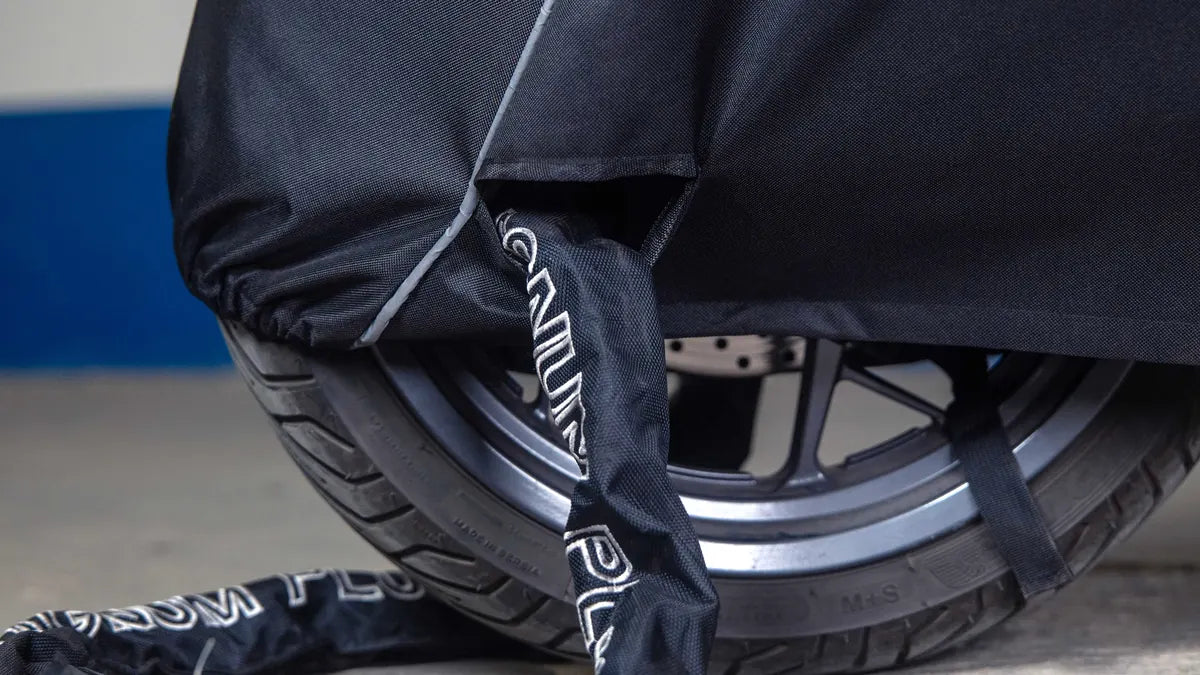
The honest conclusion is that a cover is a useful layer in a stack and a bad substitute for one. A cover is not a lock, and anyone telling you otherwise is selling you something. Pair it with a lock that passes through it (if a cover has wheel-lock slots or grommets, a disc lock or chain can go through the fabric, so the cover cannot be lifted away in one motion), park where the covered shape is in view of people or a camera, and it earns its place.
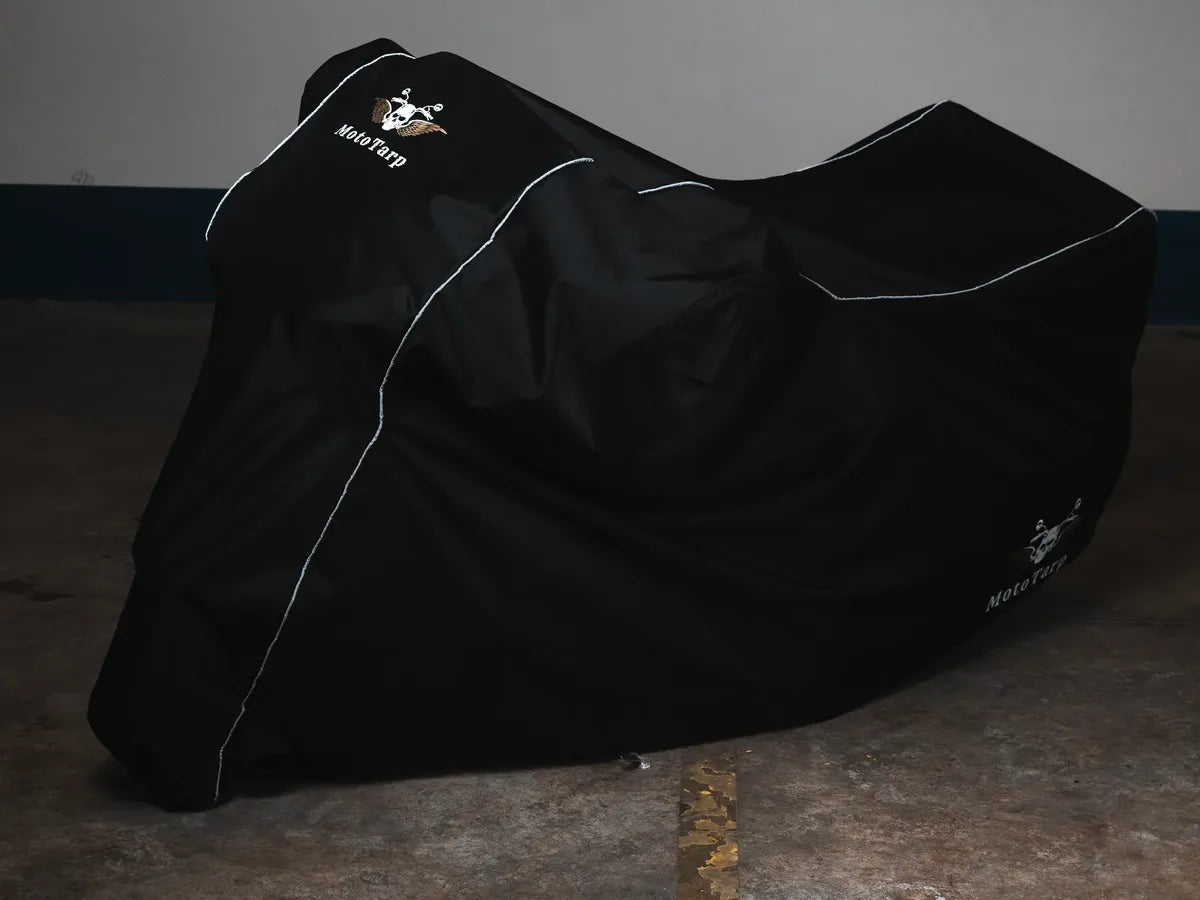
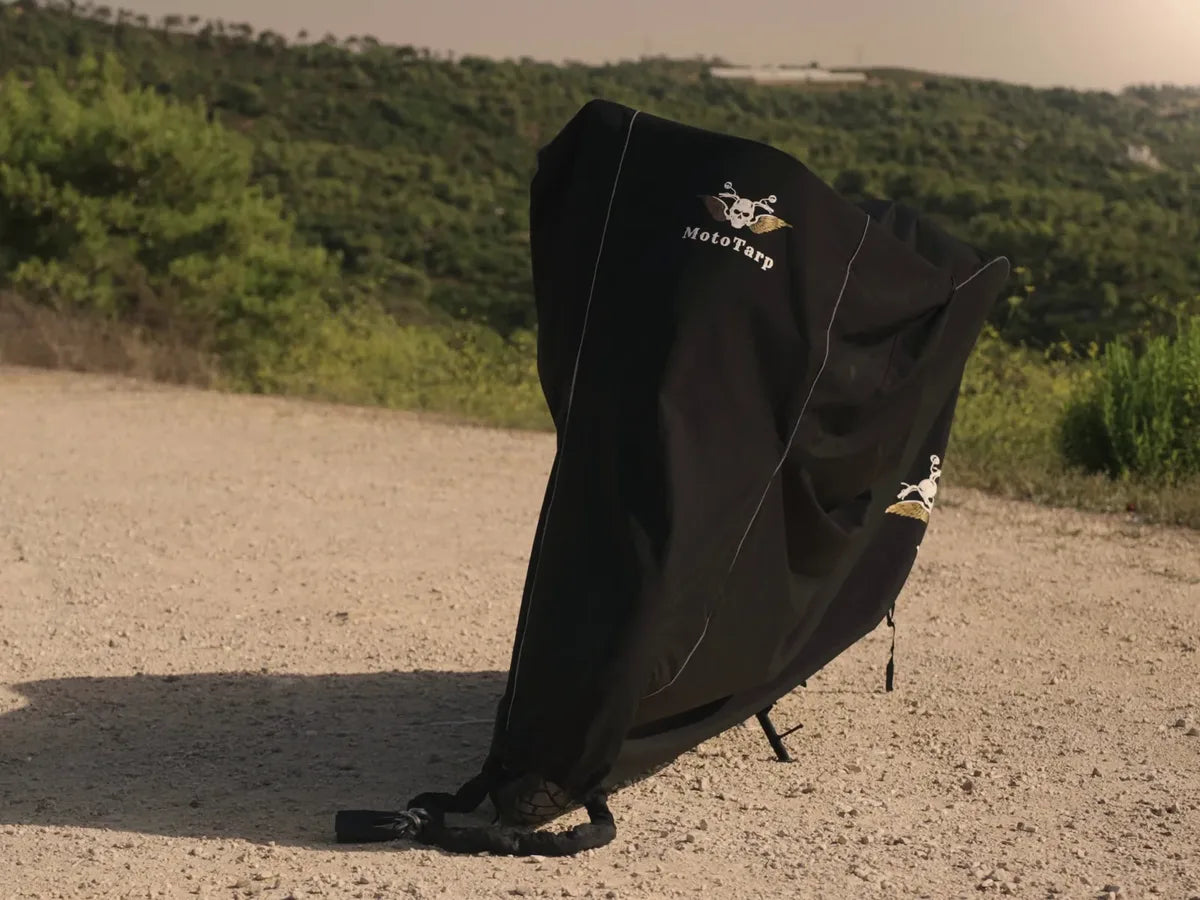
If you are choosing a cover for this job, the MotoTarp® Heavy-Duty Cover is 600D polyester in matte black, so what a passer-by sees is a plain dark shape rather than a make and model. Check the size guide for your bike.
Where should I park to avoid motorcycle theft?
Parking choice is free and it outperforms most of the paid options on this page.
Park where a person working on your bike would be seen: under a light, inside a camera's actual field of view (look at where the lens is aimed, not where the housing is mounted), overlooked by windows, near foot traffic. Avoid the dark end of the lot and the space behind the dumpsters.
And avoid one spot that riders consistently get wrong: the space closest to the exit. It is the easiest place in any parking lot to back a van up to and load unobserved, and it is usually the space people take because it is convenient.
At home, the bike being visible from your own window is worth more than most hardware.
Which motorcycle security actually works? A comparison
| Layer | Rough cost | Stops the opportunist | Stops the prepared local | Stops the van lift | Main weakness |
|---|---|---|---|---|---|
| Steering lock | Free | Partly | No | No | Forced on many bikes |
| Disc lock | Low | Yes | Briefly | No | Small shackle, cuts fast |
| Alarmed disc lock | Low–medium | Yes | Briefly | No | Useless where noise is ignored |
| Chain + matched lock | Medium–high | Yes | Yes, for a while | Only if anchored | Weight; useless lying on the ground |
| Ground anchor | Medium | Yes | Yes | Yes | Needs concrete and permission |
| Alarm / immobilizer | Medium | Yes | Partly | No | Ignored in noisy locations |
| Tracker | Low + subscription | No | No | No | Recovery only; can be found and thrown away |
| Cover | Low | Yes, it removes the bike from selection | No | No | Conceals the thief too |
| Parking choice + light | Free | Yes | Yes | Yes | Requires you to actually do it |
What is the best motorcycle security setup for my situation?
Pick the one that matches where the bike sleeps.
Home with a garage. Ground anchor set into the slab, matched chain through the frame to the anchor and held off the floor, steering lock on, disc lock as the visible extra. Then lock the garage properly: the garage door is now the outer layer, and on many houses it is the weakest part of the whole system.
Home without a garage: driveway, shared lot or street. The hardest case and the most common. Anchor if you are allowed to drill; if not, chain through something genuinely structural. Chain the frame, keep it tensioned off the ground, steering lock on, disc lock fitted. Park in the light and in view of a window or a camera, not at the far end. Then cover it, so the bike is not identifiable from the sidewalk and cannot be shopped for from a passing car. A fitted cover matters more here than anywhere else, because it goes on and off daily and has to stay put rather than sit loose over the bike; if yours has a lock opening, run the lock through it.
Overnight away from home: hotel, campsite, rally. You are carrying the security, so weight decides everything: a compact disc lock, a light chain that reaches something fixed, a cover, and a tracker. Park in the camera's view and where you can see the bike from the room. Full detail in protecting your bike on a road trip.
When is motorcycle theft most likely?
Motorcycle theft is a warm-weather problem. Bikes are out of storage, they are parked in public far more often, and they are easier to move on dry ground. The practical consequence is awkward: the months when you are least likely to be thinking about security are exactly the months when it needs to be best.
The National Insurance Crime Bureau publishes an annual report on motorcycle theft in the United States, including how thefts distribute across the months of the year and rankings by state.
What should I do in the first hour if my motorcycle is stolen?
Most guides stop at prevention. This part is worth more than much of what precedes it, because it is time-critical and almost nobody has thought about it in advance.
- Check it has actually been stolen. Towed, moved by a neighbor, relocated by the property manager. It happens more often than you would think, and it costs you two minutes.
- Call the police and file a report immediately. Have the VIN, the plate, the engine number and your insurance details ready. Keep a photo of all of them in your phone now, before you need it. The report number is what everything else hangs off.
- Pull your tracker data before it goes stale. If there is a live location, give it to the police. Do not go and collect the bike yourself.
- Walk the immediate area. Bikes are frequently pushed a short distance and left for a few hours to see whether anyone comes looking, before being collected properly. Alleys, parking lots, the next street.
- Ask neighbors and nearby businesses for camera footage today, not tomorrow. Doorbell cameras and small-business systems commonly overwrite themselves within days. This is the single most time-sensitive item on the list.
- Notify your insurer and follow their reporting process.
- Watch the marketplaces and parts sites. Whole bikes appear for sale, but stripped parts appear more often and sooner. Search your model plus your area, save the searches, and check salvage and parts listings too. If you find something, give it to the police. Do not contact the seller.
- Post it to local rider groups and forums. Riders in your area look at parked bikes more carefully than anyone else does, and this is genuinely how bikes get found.
Does insurance cover motorcycle theft?
That depends entirely on your policy, your insurer and where you live, and this is not the place to tell you what yours does. What is worth doing is reading it before you need it, and knowing the answers to four questions: whether theft is covered at all under your policy type, what your deductible is, how aftermarket parts and accessories are treated, and whether the insurer requires particular security to be fitted and used. That last one catches people out.
Call your insurer and ask. It is a ten-minute conversation and the only way to get an answer that applies to you.
Where should I start if I have no security at all?
In order of value for money:
- Use the steering lock every single time.
- Change where you park: light, sightlines, not by the exit.
- Buy a chain and lock as a matched set, and use it through the frame to something fixed.
- Fit a ground anchor if you own the concrete.
- Cover the bike so it is not shopped for in the first place.
- Add a tracker last, understanding that it is for afterward.
None of that makes your bike theft-proof. All of it makes your bike the harder one on the street, which is the actual goal. That is the part the tip lists never say out loud.
Quick answers
Do motorcycle covers prevent theft?
A cover prevents your bike from being selected, because a thief cannot see the make, model or value. It does not slow down anyone already committed, and it conceals a thief at work. Use one with wheel-lock slots so a disc lock or chain passes through it, alongside a real lock.
Is a disc lock enough on its own?
No. A disc lock secures the bike to itself, so it stops the bike being ridden or rolled but does nothing about it being lifted into a van. It deters opportunists and buys seconds against tools. Pair it with a chain to a fixed point wherever that is possible.
What is the best motorcycle lock?
A hardened chain and a matched lock, bought as a set from a security brand, used through the frame to a ground anchor and kept tensioned off the ground. Link thickness is the number that matters most, and weight rises steeply with it: a chain too heavy to carry gets left at home.
Do motorcycle trackers stop theft?
No. A tracker is a recovery tool and adds nothing to prevention. GPS units give live location but need power and a subscription; Bluetooth tags are cheap but only report when another phone passes them, and modern phones warn people that an unknown tracker is with them. Hide either one somewhere non-obvious.
Where is the safest place to park a motorcycle overnight?
Under a light, inside a camera's actual field of view, overlooked by windows and near foot traffic. Avoid the dark corner. Also avoid the space nearest the exit, which is the one people get wrong: it is the easiest place in any lot to back a van up to and load unobserved.
What should I do first if my motorcycle is stolen?
Confirm it was not towed or moved, then call the police with the VIN, plate and engine number ready. Ask neighbors and nearby businesses for camera footage the same day, before it overwrites. Pull tracker data, notify your insurer, and watch parts listings as well as whole-bike listings.
Related: Storing a motorcycle in an apartment complex, driveway or street parking · Protecting your bike on a road trip