How to Store a Motorcycle Outside for Winter (When You Don't Have a Garage)
A motorcycle can be stored outside all winter without damage, but only with preparation. Wash and fully dry the bike, add fuel stabilizer and run the engine to circulate it, put the battery on a maintainer or remove it to somewhere above freezing, set tire pressures, raise it on stands or roll it monthly, then fit a breathable tailored cover, never a plastic tarp.
That is the short version. The rest of this article is why each step matters, what happens if you skip it, and the parts almost every storage guide gets wrong.
Can you leave a motorcycle outside all winter?
Yes. Riders do it every year in Minnesota, Manitoba and Maine. But storing a motorcycle outside is genuinely worse than storing it inside, and no arrangement of covers, chemicals and good intentions makes an open parking space equal to a dry garage. Anyone who tells you otherwise is selling something.
Most of the gap is closable, though. The damage a bike takes over a winter outdoors is not caused by cold air. Cold on its own is close to harmless. It is caused by a short list of specific processes, and almost every one can be interrupted with an afternoon of work and a couple of hundred dollars of equipment. Riders who lose batteries, calipers, fuel systems and paint are usually not unlucky. They parked the bike, walked away, and left all of those processes running unopposed for five months.
Everything below assumes no indoor option at all: a parking space, a driveway, a strip of ground beside a building.
What actually damages a motorcycle left outside for four months?
Seven things, ranked by what they cost to fix.
Moisture and corrosion. Water sitting on and inside a motionless bike attacks fastener heads, brake discs, chain rollers, wheel bearings and (the expensive one) electrical connectors and switchgear. Surface rust on a disc is cosmetic and wipes off in the first few stops. Corrosion inside a connector, a caliper seal or a bearing race does not wipe off, and it is billed in labor hours.
Fuel degradation. Pump gasoline, particularly the ethanol-blended fuel sold at most US pumps, does not sit well. Over months it oxidizes and can leave gum and varnish in the fuel system: blocked pilot jets on a carbureted bike, a rough start and a filter change on fuel injection. Ethanol also draws water out of humid air, and a half-empty steel tank breathing damp air all winter rusts from the inside.
Battery sulfation. Sulfation is the build-up of lead sulfate crystals on a lead-acid battery's plates as it sits discharged; past a point it is permanent and the battery will not take a full charge again. A battery with four seasons left in it dies in one winter of neglect. It is the most common "my bike didn't survive winter" story, and the cheapest of all of these to prevent.
Flat-spotted tires. Rubber held under load at one contact patch, in the cold, for months, can take a set. It usually rolls out after some miles. On an older or harder tire it sometimes does not.
UV and freeze-thaw cycling. Sun does not stop in January. Ultraviolet fades and chalks paint, embrittles unpainted plastics and lens material, and hardens seat vinyl. Add freeze-thaw cycling (water expands as it freezes), and any moisture sitting in a seam or a hairline crack works the damage open further with every cold night. All cumulative, none reversible.
Rodents. A parked motorcycle is a dry, sheltered cavity in a cold season. Mice nest in airboxes, exhaust outlets and fairing voids, and chew wiring insulation because it is good nest material. This is how a storage mistake becomes an electrical fault you chase for a month.
Theft. A bike that has not moved in weeks is a better target than one in daily use. Nobody is coming out to it, and the owner may not notice for days.
For the full mechanism behind each of these, including the ones that matter less than people think, see what actually damages a motorcycle parked outside.
How do you prepare a motorcycle for outdoor winter storage?
Nine steps, in this order. Several are ruined if you do them out of sequence: you do not want to wash the bike after oiling the chain.
Wash it, including the underside. Not for looks. Road film, chain fling and, in northern states, road salt all hold water against metal long after the surface looks dry. A clean bike dries; a dirty bike stays damp under the dirt. Get into the swingarm, under the engine and around the shock linkage, where salt spray collects and nobody looks.
Dry it completely. Ride it around the block, or use compressed air or a leaf blower to push water out of panel gaps, switchgear, the chain, caliper recesses and under the seat. If you take one thing from this article: the bike must be dry before it is covered.
Change the oil if it is near due. Used oil holds combustion by-products, including acidic compounds and water. Leaving that against bearing surfaces for five months is a bad trade for a cheap service.
Lubricate the chain after the wash, once it is dry. A clean, dry chain outdoors will surface-rust within weeks. Get lube into the roller gaps and onto the O-rings or X-rings, not just onto the side plates.
Add fuel stabilizer, then run the engine. Add stabilizer at the dose on the bottle, fill the tank, then run the bike long enough for treated fuel to reach the injectors or float bowls. That takes a few minutes, not thirty seconds. Stabilizer sitting in the tank while untreated fuel sits in the carburetor achieves nothing. Fill close to full: less air space means less moisture condensing inside, which matters a great deal on a steel tank.
Set tires to the pressure on the bike's own placard. Use the swingarm sticker or the owner's manual, not a number from a blog. Tires lose roughly 1–2 PSI a month on their own, and more in falling temperatures, so this becomes a monthly check rather than a one-off. Michelin publishes motorcycle-specific winter storage guidance and it is a better source for tire questions than any general storage article, including this one.
Deal with the battery. Either leave it in the bike on a smart maintainer (one that floats and monitors rather than trickling continuously), or remove it and store it somewhere above freezing with a monthly top-up charge. Outside with no power available, removal is usually the only realistic option, and a battery in a warm apartment is a battery that survives. A healthy 12-volt lead-acid battery rests around 12.6–12.8 volts; if it is reading in the 12.0–12.4 range it is already part-discharged and sulfating. If yours is lithium (LiFePO4), do not assume a lead-acid charger is safe for it. Most need a lithium-specific charging profile, and manufacturers generally warn against charging a lithium pack below freezing. Check what your battery's maker says.
Apply corrosion inhibitor to exposed metal. Bare fasteners, unpainted cases, swingarm, exhaust welds, pivot points. Keep it off discs, pads, tires and anything you grip.
Block the rodent entrances. Plug the exhaust outlets and the airbox intake with steel wool or a proper exhaust plug. Tie a bright ribbon to whatever you use and leave a note on the ignition, because a spring start with a blocked exhaust is genuinely expensive. Keep the ground around the bike clear of leaves and cardboard.
Where is the best place to park a motorcycle outside for winter?
You may not have a choice. If you do, this is the ranking, best first.
| Option | Rough cost | Weather protection | Theft protection | Main drawback |
|---|---|---|---|---|
| Rented garage bay or self-storage unit | Monthly rent; non-climate-controlled units cost far less than heated ones | Complete | High | Access: a bike two towns away is a bike you will not check monthly |
| Shed you can lock | One-off cost if you already have one | Good | Moderate, and only if the bike is anchored inside | Condensation; an unventilated metal shed can be wetter inside than the air outside |
| Carport, covered balcony or building overhang | Usually free or a small parking fee | Good: no direct precipitation, most UV blocked | Low to moderate | Rain blows in sideways; check the open side against your prevailing weather |
| Against a wall, leeward side of a building | Free | Moderate: wind and rain reduced, not removed | Low | Still fully exposed from above |
| Open ground | Free | Poor without help | Low | Everything depends on the cover and the anchoring |
Wind matters more than people expect. It drives rain under covers, works fabric against paint and strips heat, so the leeward side of a building is a real upgrade over an exposed corner for zero money.
Wherever you park, look at where water goes. Avoid low points where meltwater pools, the drip line under a gutter or roof edge, and any spot under a tree. Sap and bird droppings are acidic enough to etch clearcoat, and branches come down in ice storms.
Do you need to put a motorcycle on a stand for winter?
No, but it helps, and there is a free substitute.
If you have stands, use them. Paddock stands front and rear take all load off both tires and off the suspension springs. A center stand does most of the job for the rear.
Without stands this is still manageable. Keep the tires at the correct pressure, check monthly, and roll the bike a few feet every few weeks so a different part of the tire carries the load. Two minutes of work, and most of the benefit of a stand.
Put something between the tires and the ground, such as plywood, rubber matting or carpet scraps. Concrete and asphalt both hold and transmit cold and moisture. While you are there, put a kickstand puck or a flat metal plate under the sidestand foot so it cannot sink as the ground freezes, thaws and softens.
What kind of cover do you need for outdoor winter storage?
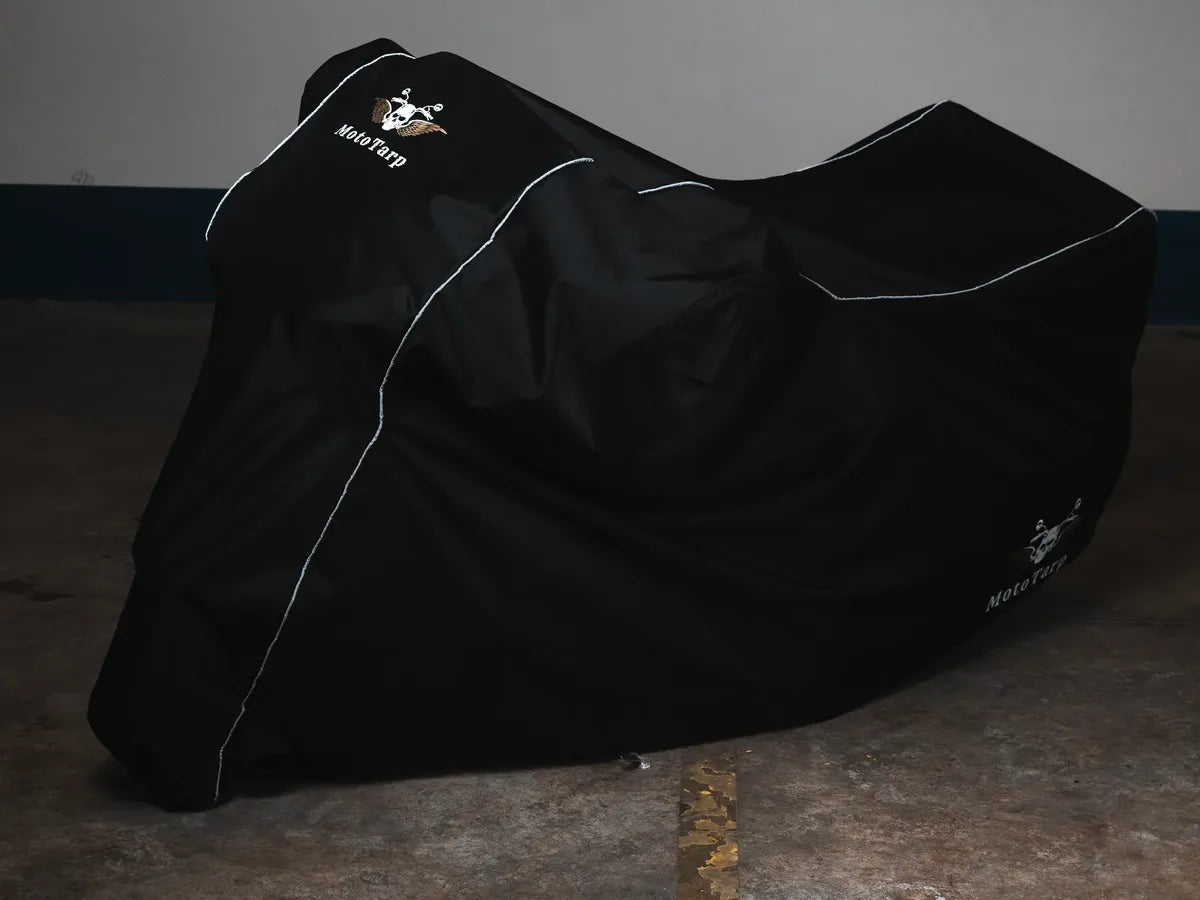
A breathable, water-resistant, tailored cover with straps or an under-bike buckle system. That combination is not marketing language. Each word solves a specific failure, and getting any one of them wrong is how a cover does more harm than good.
Does covering a motorcycle cause rust?
A non-breathable cover can, yes. Here is the mechanism, because almost no competing page explains it.
A motorcycle is never perfectly dry. There is residual moisture in the seat, in cavities, in the ground underneath and in the air itself. During the day the bike warms slightly and that moisture evaporates. Under a sealed, non-breathable sheet the vapor has nowhere to go: it condenses on the inside of the cover overnight, drips back onto the bike, and repeats every day, for months. You have not protected the bike from water. You have built it a humidity chamber.
This is why a household tarp or a sheet of plastic is worse than no cover at all. No cover means the bike gets rained on and then dries in the wind. A plastic tarp means it gets damp and stays damp. Riders who pull a tarp off in March and find rust in places the bike has never been wet are seeing exactly this.
A breathable cover is one that blocks liquid water from above while allowing water vapor to pass outward from below. That is a fabric and construction question, and it is the first thing to check about any cover you are considering. A properly breathable cover over a properly dried bike does not cause rust; a plastic sheet over a damp bike reliably does.
Why does cover fit matter more than fabric?
Because a loose cover damages paint even when the fabric is perfect.
There is always fine grit between a cover and the paint, and a loose cover in wind moves that grit across your clearcoat thousands of times a night. People blame "cover scratches" on the material. It is almost always grit plus movement, and it is a fit problem.
A loose cover also acts like a sail. It fills with air and either comes off entirely (leaving the bike exposed for however many weeks until you next visit) or drags across the bodywork as it goes. Straps, elastic hems and under-bike buckles are not styling details. They exist to stop those two failures.
Buy for the bike you actually have, including whatever is bolted to it. A touring bike with a top box, panniers and a tall screen is a different shape from the same bike bare, and fabric stretched taut over a top box corner will wear through at that corner.
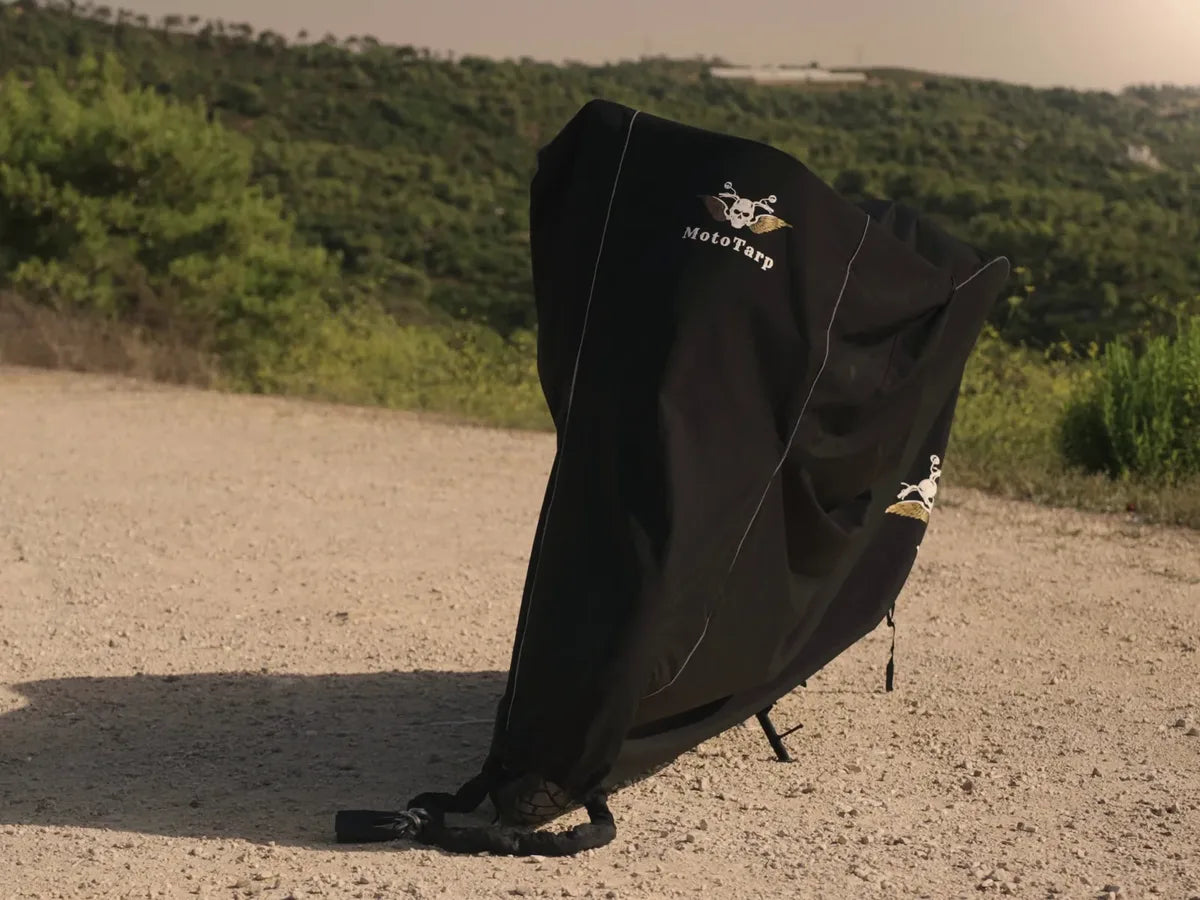
For reference, here is what the MotoTarp® Heavy-Duty Cover is, in factory-spec terms: 600D polyester fabric in matte black, 220 g/m² fabric weight, a PVC coating on the inside and a splash-repellent coating on the outside, a 10,000 mm water-pressure rating, and heat-protection panels sewn in low on both sides. To pick a size, use the size guide or the fit finder with your bike as you actually ride it.
Can you put a cover on a hot motorcycle?
No. A cover laid over hot headers or a silencer will melt, fuse to the pipe or scorch. This is the most common way covers are destroyed, and it happens because someone gets home in the rain and wants the bike covered immediately.
Two answers. Wait: twenty to thirty minutes is usually enough for pipes to stop being dangerous to fabric. Or use a cover with a heat-shield panel: an additional layer of heat-resistant material over the exhaust area, so the fabric touching the hot part is not the same fabric as the rest of the cover. It matters less for a winter layup, where the bike has been cold for weeks, and a great deal for a bike covered every night after a commute.
How do you stop a motorcycle cover blowing off?
Three things, in order of effect:
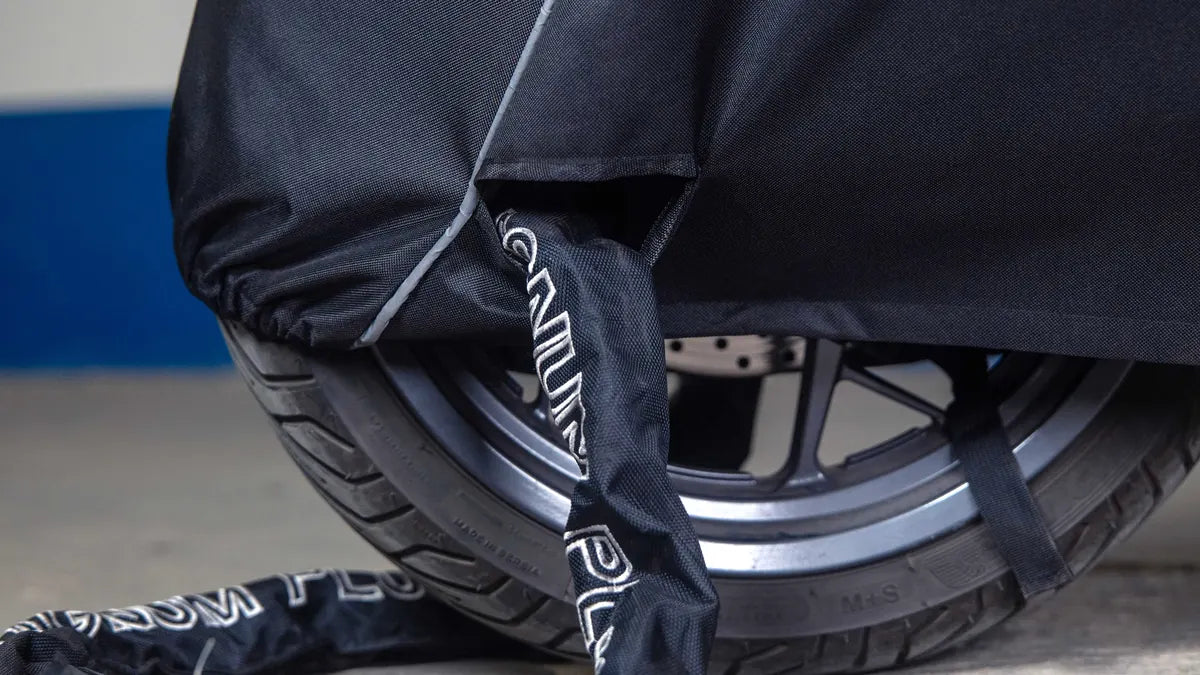
- If your cover has an under-bike strap or buckle system, tension it. This is the single most effective anti-lift measure, because it closes the gap that wind gets under.
- If your cover has lock openings or grommets, thread a lock or cable through them, so the cover is attached to the bike rather than draped on it.
- On an exposed site, add a soft tie from the cover to a fixed point (a fence post, a railing, a ground anchor) so a single gust cannot take it away entirely.
If your current arrangement is a hardware-store tarp or a loose universal cover, that is the piece worth fixing before winter rather than after it. See the MotoTarp® Heavy-Duty Cover and the size guide.
What about snow load?
A cover is not a roof. Snow that sits on it melts against the fabric, refreezes, and becomes a heavy abrasive crust that stresses the seams and presses the cover hard against the paint. After any significant snowfall, brush it off gently with a soft broom, working from the top down. Five minutes, and it is the difference between a cover that lasts several winters and one that does not.
How do you keep a motorcycle secure while it is stored outside?
Conceal it, then lock it, then anchor it. In that order, because they defeat different things.
A covered bike is a concealed bike, and concealment is genuinely valuable. Opportunist theft starts with target selection, and a shape under a cover does not tell anyone the make, the model, whether it is worth taking or whether it has an alarm.
Be clear about what that is, though: a cover is a deterrent, not a lock. Concealment buys you the chance of not being chosen; it buys nothing once someone has decided to try. For a bike sitting untouched for months, pair it with:
- A disc lock, minimum, with a reminder cable. Cheap, visible, and it defeats the walk-past-and-roll-it-away attempt.
- A chain to something immovable, held off the ground. A chain lying on concrete can be attacked by putting a link on the deck and hitting it; a chain suspended in the air, routed through the frame rather than a wheel, is a much harder problem.
- A ground anchor, if you are allowed to fit one. The biggest single upgrade for home parking, and the only measure that does anything about two people lifting the bike bodily into a van.
The full picture is in our guide to what actually slows a thief down.
What should you check on a stored motorcycle each month?
Six things, about ten minutes. Put it in your calendar.
- Lift a corner of the cover and look underneath for condensation on the tank and cases. Damp means the bike went under wet, water is getting in, or the cover is not breathing. Find out which.
- Check tire pressures. They will have dropped.
- Roll the bike a few feet if it is not on stands.
- Check the battery: voltage on the maintainer readout, or a charge cycle if it is indoors.
- Look for rodent evidence: droppings, shredded material, chewed insulation, disturbed steel wool at the exhaust.
- Look at the cover itself. Straps still tensioned, no wear point forming where fabric sits over a mirror, screen edge or top box corner, no water pooling in a slack area.
Ten minutes, five or six times over a winter, catches every problem in this article while it is still free to fix.
What should you not do when storing a motorcycle outside?
Do not start it monthly and let it idle. The most persistent piece of bad storage advice there is. A short idle never gets the engine and exhaust hot enough for long enough to evaporate the moisture combustion puts into them, so it adds water and unburnt fuel to the oil and then shuts down before boiling any of it off. It also takes more out of the battery on start-up than a few minutes of idling puts back. If you want to run it, ride it to full operating temperature. Otherwise leave it alone.
Do not use a household tarp. It is the most damaging single item in this article.
Do not cover a wet bike. If it starts raining while you are preparing, stop and finish on a dry day. A bike left uncovered for two more days is far better off than a bike sealed in wet for four months.
Do not leave the tank empty, especially a steel tank. Empty means full of humid air, and humid air condensing on bare steel all winter is how tanks rust from the inside.
Do not leave it on the sidestand on soft ground without a puck. Ground freezes, thaws and softens, and asphalt goes soft in unexpected warm spells. A stand that sinks a few inches is a bike on its side.
Do not cover it and walk away until spring. Everything here assumes six visits over a winter.
Quick answers
Can you leave a motorcycle outside all winter?
Yes, if it is prepared. Wash and dry it, stabilize the fuel, maintain or remove the battery, set tire pressures, get weight off the tires if you can, and fit a breathable tailored cover. Cold itself does very little harm; trapped moisture, stale fuel and a flat battery do most of it.
Does covering a motorcycle cause rust?
A non-breathable cover can. A plastic tarp traps evaporating moisture against the bike and condenses it back onto the metal every night. A breathable cover fitted over a fully dry bike does not, because it blocks rain and UV while letting vapor escape. Never cover a wet bike.
Should you start your motorcycle during winter storage?
No. Short idle runs add moisture and unburnt fuel to the oil and exhaust without ever getting hot enough to boil it off, and they take more from the battery than they return. Either ride the bike to full operating temperature or leave it alone on a maintainer.
Should the fuel tank be full or empty for winter storage?
Close to full, with stabilizer added and the engine run for a few minutes so treated fuel reaches the injectors or float bowls. A near-full tank leaves little air space for moisture to condense in, which matters most on steel tanks that rust from the inside.
Do you need a stand for winter storage?
It helps but it is not essential. Stands take load off the tires and suspension. Without them, keep tires at placard pressure, put plywood or matting between rubber and cold ground, and roll the bike a few feet every few weeks so a different part of the tire carries the weight.
How often should you check a motorcycle stored outside?
Monthly, for about ten minutes. Look under the cover for condensation, check tire pressures and battery voltage, roll the bike, check for rodent evidence, and confirm the cover straps are still tensioned with no wear points forming.
Coming back to it in spring
Do not just turn the key in March. A bike that has sat for five months needs a proper pre-start inspection, in order, and our spring checklist covers what to check before you touch the starter, including the damage audit that tells you what your storage setup got wrong.
Related: What actually damages a motorcycle parked outside (and what doesn't) · Motorcycle theft prevention: what actually slows a thief down · Getting your motorcycle out of winter storage: a spring checklist