How to Choose a Motorcycle Cover: What Actually Matters
The best motorcycle cover is the one that fits your bike as you actually park it, sheds rain with a stated water-pressure rating rather than a vague "waterproof" label, and stays on in wind because it clips under the bike. Fabric weight and denier matter, but fit and hold-down matter more: a heavy cover that flaps will scuff paint and blow off, and a light cover that fits will not.
This guide walks through what to check, in the order it matters, and what each spec on a product page actually means.
What is the most important thing when choosing a motorcycle cover?
Where the bike lives. Everything else follows from that.
A bike in a dry garage needs a cover that keeps dust off and lets the bike breathe. A bike on a driveway or in an apartment lot needs a cover that keeps rain and sun off, survives wind, and can be locked to the bike. Those are different products. We explain the difference in detail in indoor vs outdoor motorcycle covers.
If you are still deciding whether a cover is the right answer at all, or whether to pay for a garage, carport or storage unit, start with cover vs garage vs carport.
What should you look for in an outdoor motorcycle cover?
Six things. The table puts them in order of how often getting them wrong ruins a cover or a paint job.
| What to check | Why it matters | What a good answer looks like |
|---|---|---|
| Fit for your bike as equipped | A loose cover flaps, drags grit across paint and acts like a sail | A size chosen from your bike's make, model and add-ons, not from "fits most bikes" |
| Hold-down system | Wind gets under the hem and lifts the cover off | Straps that clip under the bike, plus elastic at the hems |
| Water resistance | Rain is the main reason most riders buy a cover | A coated fabric with a stated water-pressure rating in millimeters |
| Fabric strength | Thin fabric tears at mirrors, levers and screen edges | A stated denier and fabric weight, not just "heavy-duty" |
| Heat protection | Hot pipes melt ordinary fabric | A heat-resistant panel low on the side, and the habit of letting the exhaust cool anyway |
| Security | A cover that lifts off in one motion is easy to steal or remove | An opening you can run a disc lock or chain through |
Why does fit matter more than fabric?
Because almost every kind of cover damage comes from movement, not from the fabric.
There is always fine grit between a cover and the paint. A cover that moves in the wind rubs that grit across the clearcoat all night. Riders blame the material; it is nearly always fit plus wind. A loose cover also fills with air and either drags across the bodywork or leaves entirely.
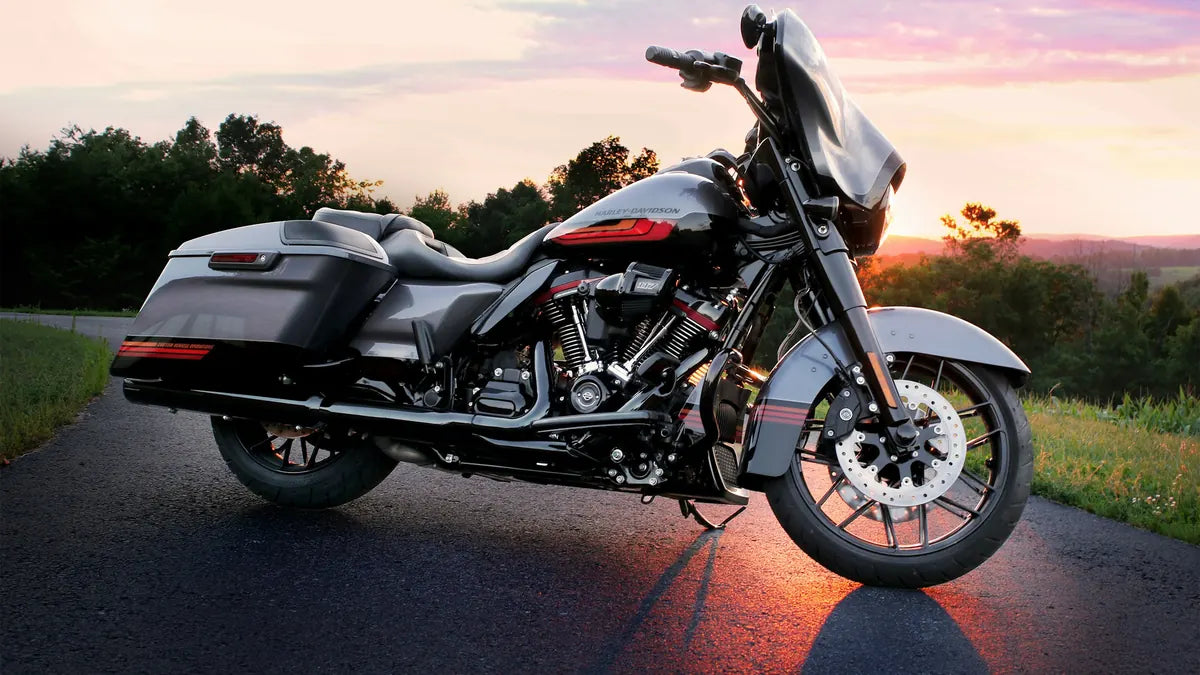
Fit means the bike as you park it. A touring bike with a fairing, hard bags and a top case is a much bigger shape than the same bike stripped. If you have added a taller windshield, a sissy bar or luggage, the cover has to clear those too. For big touring bikes, we cover what changes the size in what size cover fits a Harley touring bike, and trikes in covers for trikes and big touring bikes.
When you are between two sizes, the larger one is usually the safer choice: a cover that is slightly long can be snugged down with straps, while a cover that is too tight strains its seams and wears through at corners like a top case or mirror.
What does 600D mean on a motorcycle cover?
The "D" is denier, a measure of how thick the individual yarns are. Denier is the weight in grams of 9,000 meters of the yarn, so a higher number means a heavier, thicker yarn.
Two things to keep in mind. First, denier describes the yarn, not the finished fabric: weave, coating and the type of fiber all change how the cover performs. Second, denier and fabric weight are different numbers. Fabric weight, usually given in grams per square meter, tells you how much material there is in each square of cloth. A product page that gives both is telling you more than one that gives neither. For the longer explanation, read what 600D means.
Is a waterproof motorcycle cover really waterproof?
"Waterproof" on a cover label is a word, not a measurement. It does not tell you how much water pressure the fabric can hold back, whether the seams were tested, or whether anything was tested at all. A number is more useful.
The number to look for is a water-pressure rating, also called hydrostatic head, given in millimeters. In the standard test, ISO 811, a piece of fabric is clamped under a column of water, the pressure is raised steadily, and the result is the pressure at which water comes through in three places. A higher millimeter figure means the fabric holds back more water pressure.
Two limits on that number. It describes the coated fabric, not the seams, zippers or openings, which is where most leaks happen. And it says nothing about breathability. More on how to read the rating in motorcycle cover water ratings explained.
Does a motorcycle cover need to be breathable?
It helps, but there is a trade-off, and it is worth being honest about it.
Fabrics that hold back the most water are usually coated, and a coating that stops liquid water also slows water vapor. Fabrics that breathe well usually hold back less rain. No cover gets both for free.
What causes trouble under any cover is moisture that is already on or in the bike when the cover goes on. During the day it evaporates; at night it condenses on the inside of the fabric and drips back down. The fix is the same whatever cover you own: cover a dry bike, park off wet grass where you can, and after a long wet spell take the cover off on a dry, breezy day so everything can air out. We go through the causes in what actually damages a motorcycle parked outside.
The one thing never to use is a plastic tarp. It holds water in, has no hem or straps to stop it flapping, and does more harm than leaving the bike bare.
Can you put a cover on a hot motorcycle?
Not straight away. Exhaust pipes stay hot well after you switch off, and most cover fabric will melt or scorch on contact. A heat-resistant panel near the exhaust reduces the risk, but unless the maker publishes a temperature rating for that panel, assume it is a safety margin, not permission. Let the pipes cool before you cover. The details are in can you put a cover on a hot motorcycle.
How do you stop a cover blowing off?
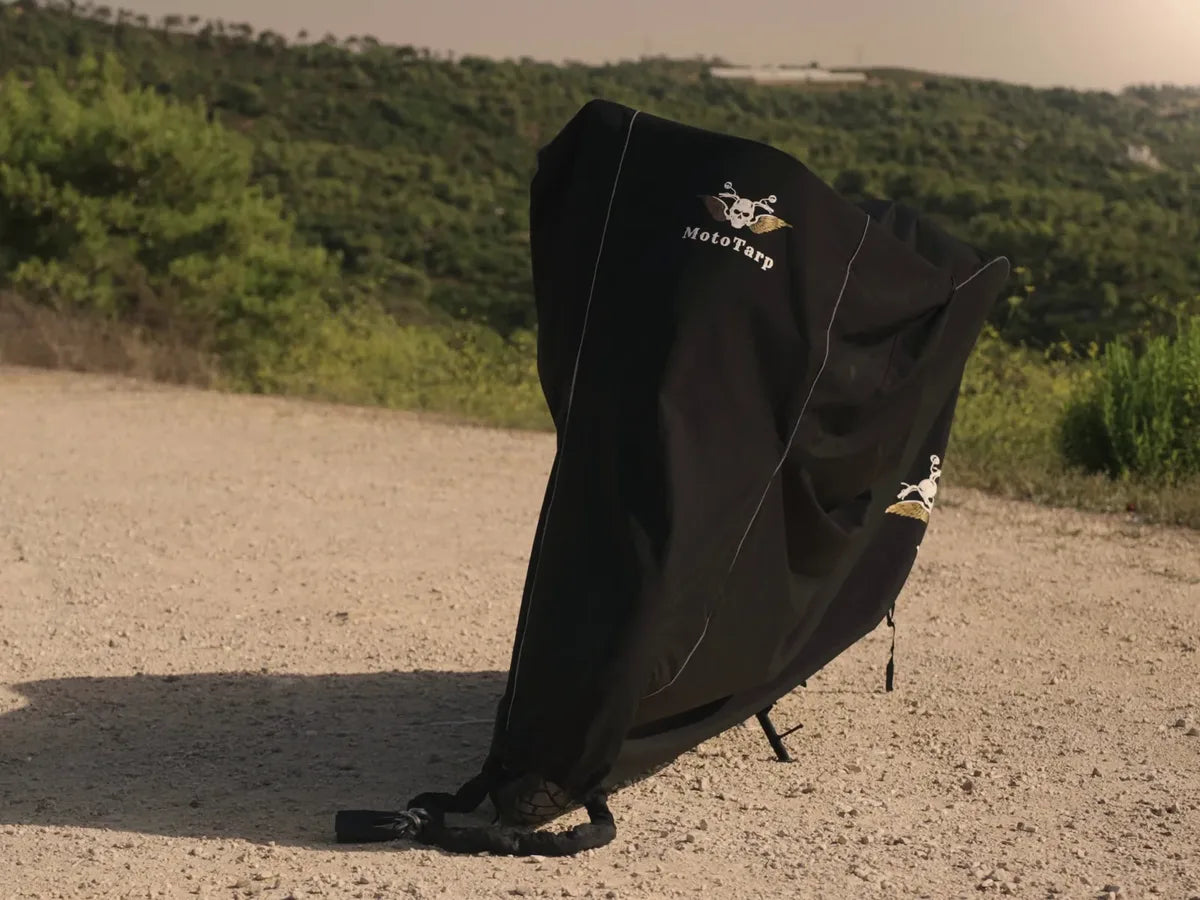
Look for three features: straps that clip under the bike, elastic at the front and rear hems, and an opening you can run a lock through. The straps close the gap the wind gets into, the elastic holds the hem around the wheels, and the lock ties the cover to the bike. On an exposed site, a soft tie from the cover to a fence or railing adds a fourth layer. More in how to stop a motorcycle cover blowing off.
Does a motorcycle cover stop theft?
It helps a little and only in one way. A plain cover hides the make, model and accessories, so a thief walking past learns nothing about whether the bike is worth the effort. It does not stop anyone who has already decided to try. Pair the cover with a disc lock or a chain, run through the cover so the cover cannot be lifted off without unlocking it. Our theft prevention guide covers the rest.
What about the small things?
They decide whether you actually use the cover every day.
- A storage bag you will use. A wet cover will not go back into a tight bag. A roomy bag with handles goes on the bike.
- How it goes on. A clear front and back means under a minute. If it takes five, you will skip it on the nights it matters.
For a printable version of everything above, use the motorcycle cover buyer's checklist.
Where MotoTarp® fits
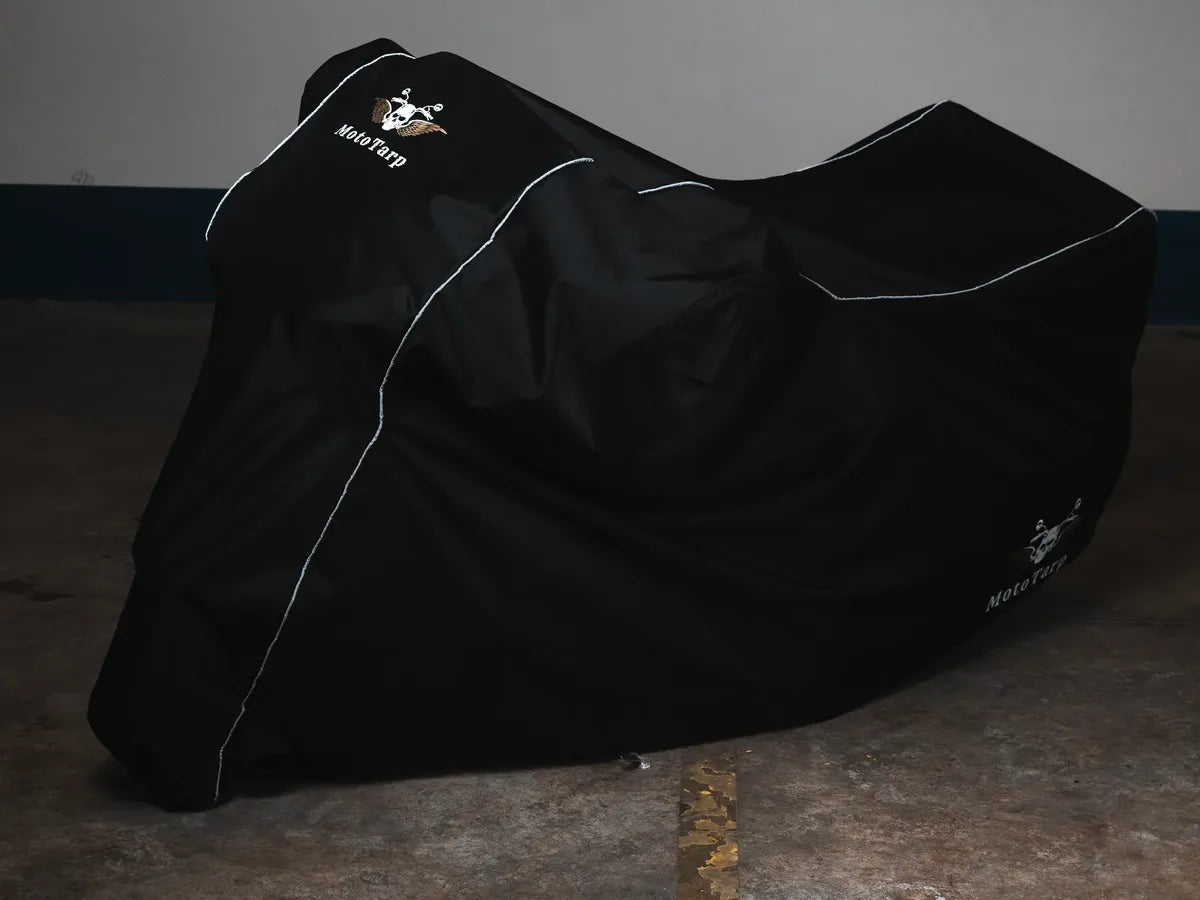
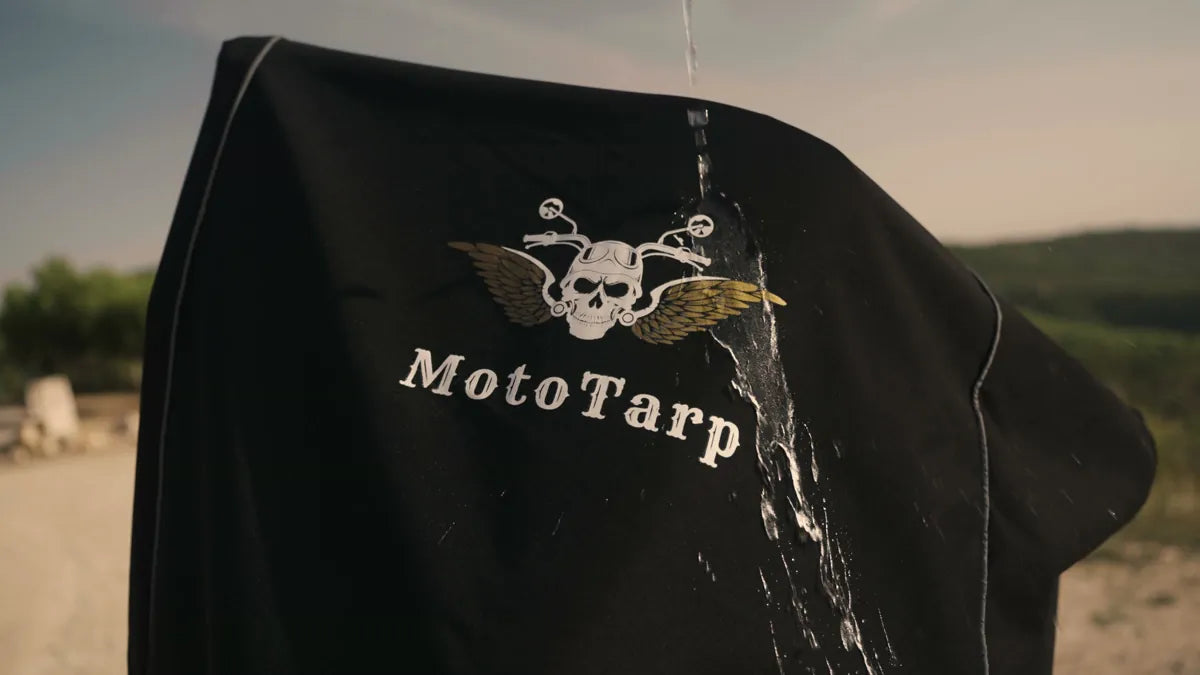
We make one product, so here is exactly what it is, in factory-spec terms. The MotoTarp® Heavy-Duty Motorcycle Cover is matte black 600D polyester with a 220 g/m² fabric weight, a PVC coating on the inside and a splash-repellent coating on the outside, and a 10,000 mm water-pressure rating for the coated fabric. It is water-resistant. Heat-protection panels are sewn in low on both sides; we do not publish a temperature rating for it, so let the exhaust cool before you cover. It has straps that clip under the bike, elastic at the front and rear hems, an opening for a disc lock or chain, and a storage bag with a two-way zipper, two pullers and two reinforced handles. Because it is a coated cover, the dry-bike rule above applies to it fully.
It comes in six sizes, from Large to 6XL/Trike. To pick one, use the fit finder with your bike's make, model and add-ons, or check the size guide.
Quick answers
What is the best motorcycle cover?
The one that fits your bike as you park it, has a stated water-pressure rating, and clips under the bike so it stays on in wind. Fit and hold-down matter more than any single fabric number.
What does 600D mean?
600 denier: the yarn weighs 600 grams per 9,000 meters. It tells you how thick the yarn is, not how the finished cover performs; weave, coating and fabric weight matter too.
Are waterproof motorcycle covers really waterproof?
"Waterproof" on a label is not a measurement. Look for a water-pressure rating in millimeters, and remember it describes the fabric, not the seams or openings.
Should a motorcycle cover be breathable?
Breathability helps, but the most water-resistant fabrics are coated and breathe less. Whatever cover you use, put it on a dry bike and air it out after long wet spells.
Should I size up or down on a motorcycle cover?
If your bike falls between two sizes, take the larger one. Straps can take up slack, but a cover that is too tight strains seams and wears through at corners.
Is a cheap cover better than no cover?
A loose cover with no straps can do more harm than none, because it flaps grit across the paint and blows off. A plastic tarp is the worst option because it traps moisture.