How to Stop a Motorcycle Cover Blowing Off in the Wind
A motorcycle cover blows off when wind gets underneath it and it acts like a sail. To stop it, close the gaps at the bottom (elastic hems and straps that clip under the bike, pulled snug), make sure the cover is the right size so there is no loose fabric to catch the wind, run a lock through the cover so it cannot be carried away, and park so the bike's narrow end faces the wind.
Each of those fixes a different part of the problem. Here is how wind actually takes a cover, what to do about it in order of effect, and what to do on the nights when the forecast says the wind is going to win anyway.
Why do motorcycle covers blow off?
Wind flowing over a covered bike pushes on the windward side and pulls on the top and the sheltered side. That alone rarely removes a cover. What removes it is air getting underneath. Once the hem lifts, the cover inflates, the inflated cover catches more wind, and the cycle builds until it slides off the back or rolls off the side.
Three things make that easier:
- An open hem. A cover that hangs loose around the wheels gives wind a way in.
- Spare fabric. A cover that is too big has slack panels that flap, and every flap pumps more air underneath.
- Nothing holding it to the bike. A cover that is only draped over the bike can be lifted away in one piece.
Flapping also damages paint before the cover ever leaves. Fine grit between fabric and paint is scrubbed back and forth with every gust. That is a fit problem as much as a wind problem; see what actually damages a motorcycle parked outside.
How do you keep a motorcycle cover on in wind?
In order of effect:
1. Close the bottom: hems and under-bike straps
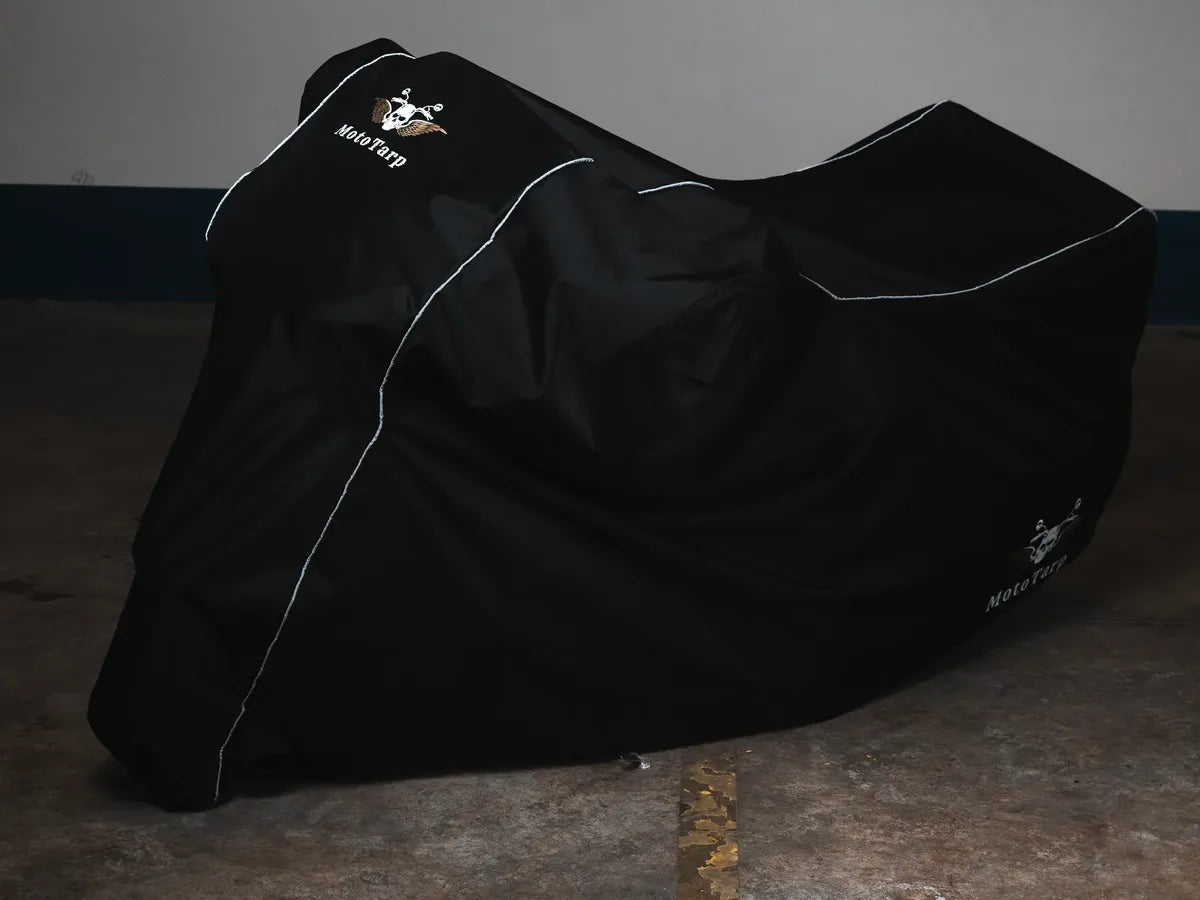
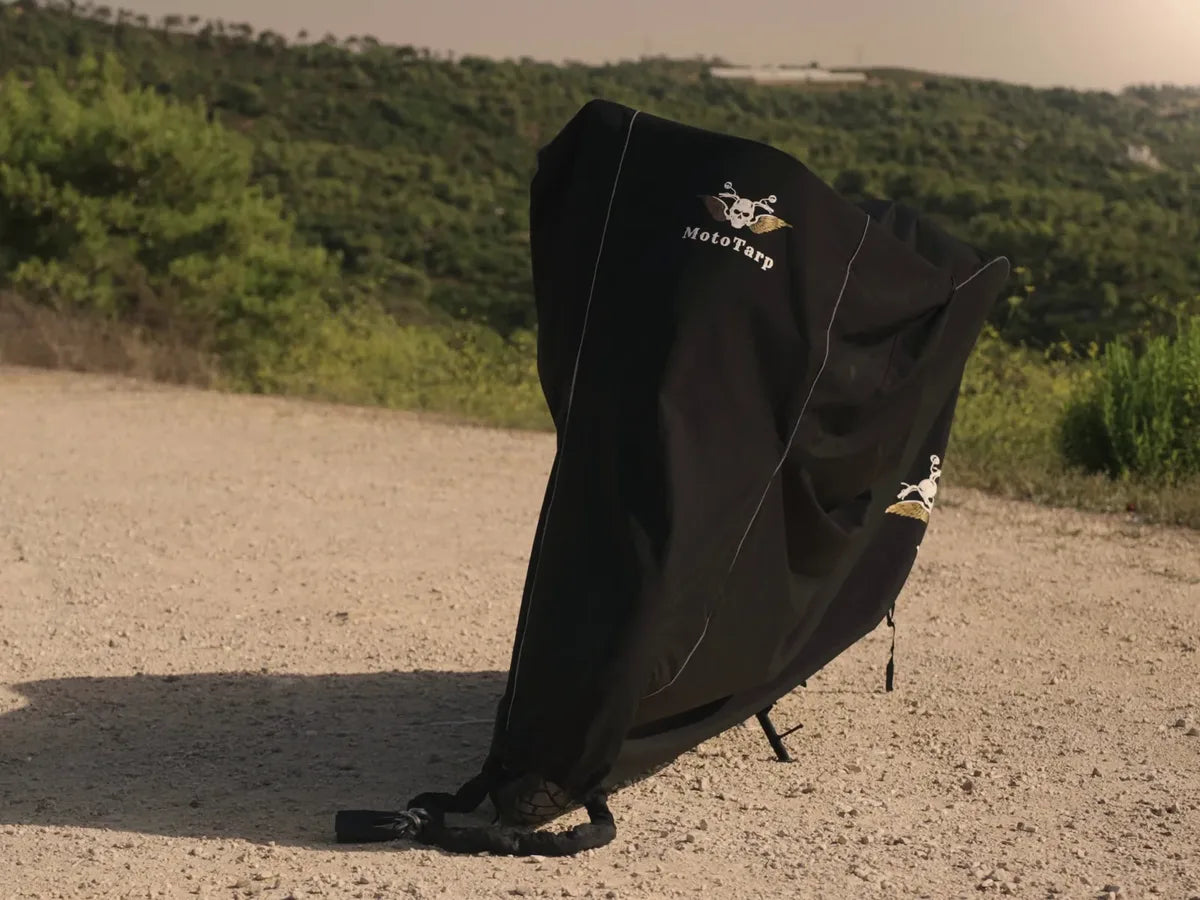
This does the most, because it shuts the door the wind comes in through. Elastic at the front and rear hem pulls the cover in under the wheels; straps that clip under the bike pull the sides together beneath the engine or frame. Pull them snug every time, not just on windy nights. A strap left loose because the night looked calm is the strap that was needed at 3 a.m. (Our own MotoTarp® cover uses exactly this pair: elastic at the front and rear hem, and straps that clip under the bike.)
Route straps where they cannot slide: around a frame tube or under the engine, clear of the exhaust and anything sharp. On a bike with low fairings or a skid plate, find a path that does not pull the strap across a hot or sharp edge.
2. Get the size right
A cover that fits has no spare fabric to catch the wind. A cover that is too small is not the answer either: it rides up, will not reach under the wheels, and stretches tight over corners where it wears through. Size for the bike as you actually park it, with the windshield, bags and top case on. Our guide to choosing a cover covers fit in more detail, and touring bikes and trikes have their own guide: covers for trikes and big touring bikes.
3. Lock through the cover
If your cover has a lock opening, run a disc lock or a chain through it. That attaches the cover to the bike rather than leaving it draped on top. Wind may still lift a corner, but it cannot carry the whole cover off into the street, and neither can a passer-by. The lock also secures the bike, which matters more than the cover; see what actually slows a thief down.
One warning: if you use a disc lock, use a reminder cable and route it to the handlebar. Riding off with a disc lock still fitted is a fast way to damage a brake disc and drop the bike.
4. Tie off to something fixed on exposed sites
On an open lot, a rooftop or a coastal driveway, add a soft tie from the cover's strap or lock point to a fence post, railing or ground anchor. If the bike is already chained to a ground anchor, the chain through the cover does this job.
Which way should you park a motorcycle in the wind?
Two things to think about: the cover, and the bike itself.
For the cover, point the front of the bike into the prevailing wind. The front of a motorcycle, especially one with a fairing or windshield, is the narrow, shaped end, and the cover sits closely over it. Wind arriving from the front flows over the bike. Wind arriving side-on hits the largest flat area, and wind from behind pushes into the rear of the cover where the shape is often baggier.
For the bike, think about which side the stand is on. On a bike leaning on its sidestand, a strong gust from the stand side pushes it toward upright and, past that, over onto the other side. A gust from the opposite side pushes it harder onto the stand, which is more stable. A cover adds surface area for the wind to push on, so on a very windy site, the stand side matters more than usual. On soft ground, use a sidestand puck so the stand cannot sink.
Where you can, use shelter: the lee side of a building, a wall, a fence or a parked vehicle cuts the wind considerably. Avoid gaps between buildings, which funnel wind. For the bigger picture of where to park, see storing a motorcycle in an apartment complex, driveway or street parking and cover vs garage vs carport.
How windy is too windy for a motorcycle cover?
There is no single answer, because shelter, fit and how well the cover is secured make far more difference than a forecast number. The National Weather Service's Beaufort wind scale is a useful way to translate a forecast into what you will see outside:
| Beaufort force | Wind speed | What you see on land (NWS) | What to do with a covered bike |
|---|---|---|---|
| 4 (moderate breeze) | 13–18 mph | Raises dust and loose paper; small branches move | Normal fitting: hems and straps snug |
| 5 (fresh breeze) | 19–24 mph | Small trees in leaf begin to sway | Check straps; lock through the cover |
| 6 (strong breeze) | 25–31 mph | Large branches in motion; umbrellas used with difficulty | Tie off on exposed sites; check stand side and footing |
| 7 (near gale) | 32–38 mph | Whole trees in motion; walking against the wind is inconvenient | Move to shelter if you can; consider leaving the bike uncovered |
| 8 (gale) | 39–46 mph | Twigs break off trees; progress generally impeded | Shelter the bike; a cover adds wind load to a bike that may already be at risk |
The right-hand column is our practical advice, not part of the NWS scale. Gusts matter more than the average wind speed, so read the gust figure in the forecast.
Should you take the cover off in a storm?
Sometimes, yes. In very strong wind on an exposed site, a cover adds surface for the wind to push on, and the risk shifts from "the cover blows off" to "the bike blows over." A bike on its side damages levers, mirrors, bodywork and fuel-tank paint, and it can leak fuel.
If a severe wind warning is forecast and you cannot move the bike to shelter, it is reasonable to remove the cover for the night, lock the bike, and put the cover back on afterward. Rain for one night does far less harm than a fall. If you keep it covered, make sure the straps are tight, the lock runs through the cover, and the bike is on firm ground with the wind on the side opposite the stand.
What not to do
- Do not weigh the cover down with bricks or rocks on top. They slide, scratch the paint, and fall when the cover moves.
- Do not use bungee hooks across painted parts. A hook that lets go under tension hits whatever is nearest.
- Do not cinch a cover tight over a hot exhaust. Snugging the fabric down brings it closer to the pipe. Let the bike cool first; see can you put a cover on a hot motorcycle.
- Do not use a household tarp. It catches wind, flaps against the paint and traps moisture.
Quick answers
How do I stop my motorcycle cover blowing off?
Close the bottom of the cover with its elastic hems and under-bike straps pulled snug, use the right size so there is no loose fabric, run a lock through the cover's lock opening, and park with the front of the bike into the wind or in the lee of a building.
Why does my motorcycle cover keep blowing off?
Wind is getting underneath it. That usually means the hem is open, the straps are loose or missing, or the cover is too big and flaps. Fix the gap at the bottom first.
Which way should I park my motorcycle in wind?
Nose into the prevailing wind for the cover, and where possible with the wind hitting the side opposite the sidestand, which pushes the bike onto its stand rather than off it.
Should I cover my motorcycle in high winds?
In ordinary wind, yes, with the straps tight and a lock through the cover. In a severe wind warning on an exposed site, move the bike to shelter or consider leaving it uncovered and locked for the night, because a cover adds wind load.
Does a lock through the cover stop it blowing away?
It stops the whole cover being carried away and stops someone lifting it off, because the cover is attached to the bike. It does not stop the hem lifting; the straps and elastic do that.
Where MotoTarp® fits
The MotoTarp® Heavy-Duty Cover has elastic at the front and rear hem, straps that clip under the bike and a lock opening for a disc lock or chain, the three features this guide relies on. It comes in six sizes from Large to 6XL/Trike, and the fit finder picks the one for your bike as you park it.
Related: How to store a motorcycle outside for winter · Protecting your bike on a road trip · Motorcycle cover buyer's checklist