Motorcycle Covers for Trikes and Big Touring Bikes: What Changes and How to Measure
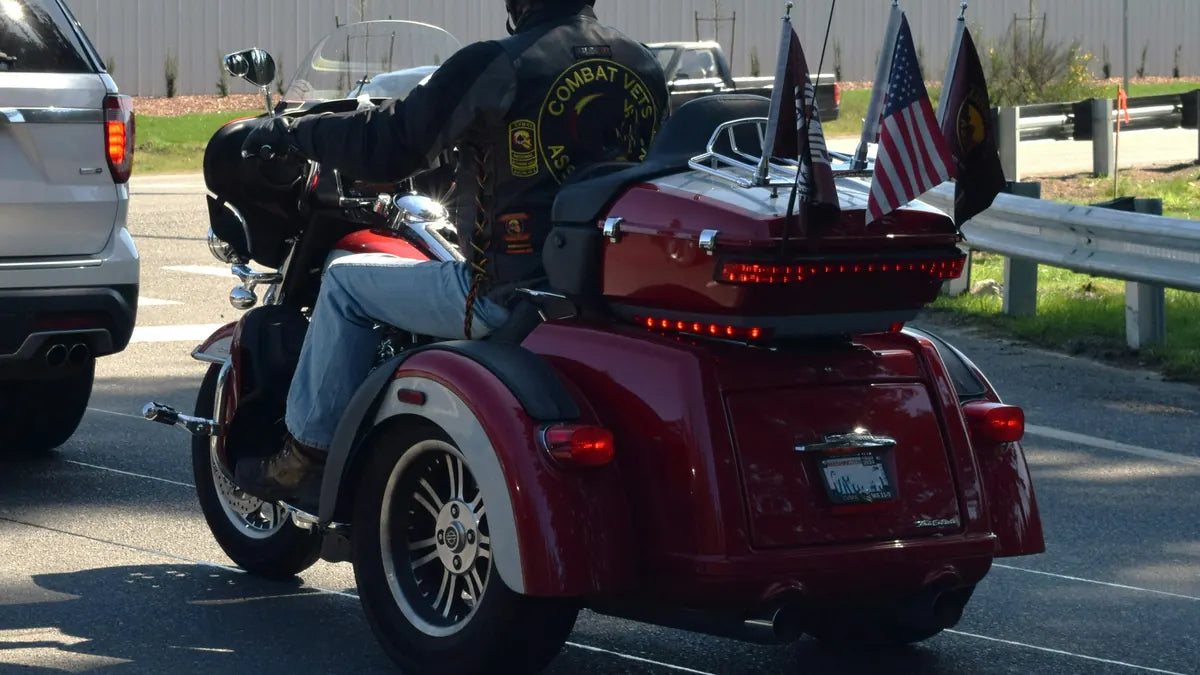
Trikes and big touring bikes need covers sized for what is bolted to them, not for the bike's model name. A top case, hard saddlebags, a full fairing, a tall windshield or a trike's wide rear body each change the length, width or height the cover has to clear. Measure the bike as you park it, compare those three numbers with the cover maker's size guide, and check how the cover is held down underneath, because big bikes and trikes catch a lot of wind.
This guide walks through what changes on touring bikes and trikes, how to measure, and the fit problems that show up most often on large machines.
Why do touring bikes need a different cover?
Because the shape is different, not just the size. A bare cruiser is long and low with a fairly even profile. A fully dressed touring bike adds bulk at specific points, and those points are where covers go wrong.
| Add-on | What it changes | Common cover problem |
|---|---|---|
| Top case (on Harley-Davidson touring models, the Tour-Pak) | Adds height and length at the rear, plus a sharp-cornered box | Cover will not reach down over the rear wheel; fabric pulled tight wears through at the box corners |
| Hard saddlebags or panniers | Adds width at the rear, often the widest point of the bike | Hem cannot close under the bike; straps cross the bags instead of the frame |
| Full or batwing fairing | Adds width and bulk at the front | Front of the cover rides up; mirrors on the fairing push through or stretch the fabric |
| Tall or touring windshield | Adds height at the front | Front hem lifts off the front wheel; wind gets under the front |
| Backrest or sissy bar | Adds height behind the seat | A tent-like peak that catches wind and rubs |
| Highway bars and auxiliary lights | Adds width low at the front | Snags and abrasion points near the hem |
| Antennas | Adds a tall, thin point | Pokes the fabric; can wear a hole. Fold down or remove if your bike allows |
The same model can be any of these shapes. A touring bike from the factory without a top case, with an accessory top case, with a lower trunk rack, or with a passenger backrest instead, will each need a different amount of cover. That is why sizing by model name alone is unreliable, and why our own fit finder asks what is fitted to the bike as well as the make and model. For Harley-Davidson touring models specifically, see what size motorcycle cover for Harley touring bikes.
What is different about covering a trike?
Three-wheelers come in two layouts, and they need covers with very different shapes. As Can-Am explains in its guide to what three-wheel motorcycles are called:
- Conventional trikes have one wheel at the front and two at the rear. The rear body, with its two fenders and trunk, is the widest part, often much wider than a two-wheeler's saddlebags.
- Reverse trikes have two wheels at the front and one at the rear; Can-Am calls this its Y layout. The width is at the front, around the front wheels and bodywork.
What this means for a cover:
- Width matters as much as length. A two-wheeler cover is shaped around a narrow bike with wider bags at the back. A trike needs width where its wheels are.
- The hem has further to close. On a two-wheeler, under-bike straps pull together beneath a narrow frame. On a trike, the distance from one side to the other is much greater, so look at how and where the straps attach and whether they can reach under the body without crossing the exhaust.
- Trikes are big wind targets. A large, boxy shape gives the wind a lot to push on. Fit, straps and a sheltered parking spot matter even more than on a two-wheeler. See how to stop a motorcycle cover blowing off.
- Exhausts may sit in unusual places. On some trikes the exhaust exits under or behind the rear body. Wherever it is, let it cool before covering; see can you put a cover on a hot motorcycle.
Before you buy, check that a cover is designed for a trike, and for which layout. A cover that fits a conventional trike well will not necessarily fit a reverse trike, and the other way round.
How do you measure a touring bike or trike for a cover?
Measure the bike exactly as it is parked, with everything fitted that will be under the cover. You need three numbers. A helper and a long tape measure make it easier; for height, a straight board or level laid across the top helps.
- Length: from the front of the front tire (or the front of the fairing, highway bars or front bodywork, whichever sticks out further) to the rearmost point. On a dressed tourer or trike, that is usually the back of the top case, the rear rack, the rear fender or a trailer hitch.
- Width: across the widest point. On a touring bike that is usually the saddlebags, the fairing mirrors or the highway bars. On a conventional trike it is the rear body; on a reverse trike, the front wheels or front bodywork.
- Height: from the ground to the highest point. Usually the top of the windshield at the front, and the top of the top case or backrest at the rear. Measure both: covers are often shaped with different front and rear heights, so a bike can be within a cover's front height and still too tall at the back, or the other way round.
Write the numbers down with what was fitted when you measured. If you later add a taller windshield or a top case, measure again.
Then compare your three numbers with the maker's chart. For MotoTarp®, that is the size guide, or let the fit finder work it out from your make, model and add-ons. The range runs to six sizes, from Large to 6XL/Trike; which of them suits your bike is the fit finder's job, not a guess from the model name.
What are the common fit problems on big bikes?
Too tight over the top case. Fabric under constant tension over a hard corner wears through at that corner, and a cover that is tight at the top tends to ride up off the wheels at the bottom. If the cover only just reaches, it is too small.
Too loose everywhere else. Choosing a very large cover to clear one tall point can leave slack fabric at the front and sides that flaps and scuffs paint in wind. A cover with the right shape matters as much as one with the right maximum size.
Mirrors and windshield edges. Fairing mirrors and screen edges are the other common wear points. Check them on your monthly look under the cover; the winter storage guide has the full ten-minute check.
Straps that cannot reach. Wide saddlebags and trike bodies push the cover's sides outward. Check that the straps clip together under the bike at a point that does not cross the exhaust, the drive belt or a sharp edge.
Heavy covers that never get used. A cover for a big touring bike or trike is a lot of fabric. If it is hard to fit and fold, it ends up in the garage instead of on the bike. A storage bag with sturdy handles makes the routine easier.
Is a cover enough for a big touring bike parked outside?
For weather, a well-fitted outdoor cover does most of the job; for theft, no cover is a lock. Touring bikes and trikes are valuable and conspicuous, and a cover mainly conceals. Pair it with a disc lock or a chain through the cover's lock opening, and a ground anchor where you can fit one. See what actually slows a thief down, and for life on the road, protecting your bike on a road trip. If you have a choice about where the bike lives, cover vs garage vs carport compares the options.
Quick answers
What size cover do I need for a touring bike with a top case?
Measure the bike with the top case fitted: length to the back of the case, width at the widest point, and height at both the windshield and the top of the case. Then use the cover maker's size guide or fit finder. Do not size from the model name alone.
Do trikes need a special motorcycle cover?
Usually, yes. Trikes are much wider than two-wheelers where their paired wheels are, at the rear on a conventional trike and at the front on a reverse trike. Check that a cover is made for trikes and for your layout.
How do I measure my motorcycle for a cover?
With everything fitted that will be under the cover, measure overall length, width at the widest point, and height at the highest points front and rear. Compare those numbers with the maker's chart.
Does a tall windshield change my cover size?
It can. A taller windshield raises the front height the cover has to clear, and a cover that is too short at the front lifts off the front wheel and lets wind in. Re-measure after changing your windshield.
What sizes does MotoTarp® make?
Six sizes, from Large to 6XL/Trike. To choose one for your bike, use the fit finder or the size guide rather than guessing from the model name.
Where MotoTarp® fits
The MotoTarp® Heavy-Duty Cover comes in six sizes from Large to 6XL/Trike, in 600D polyester with a PVC inner coating, elastic front and rear hems, straps that clip under the bike, a lock opening and heat-protection panels sewn in low on both sides. Tell the fit finder your make, model and what is fitted to it, and it will suggest the size.
Related: How to choose a motorcycle cover · Motorcycle cover buyer's checklist · Indoor vs outdoor motorcycle covers