Motorcycle Cover Buyer's Checklist (Printable)
Before you buy any motorcycle cover, check five things: that it is sized for your bike with its windshield and luggage fitted, that it holds down with straps under the bike and elastic hems, that it states a water-pressure rating in millimeters instead of just saying "waterproof", that it gives a denier and fabric weight, and that it has a heat-resistant area near the exhaust and an opening for a lock. This checklist puts every point on one page you can print and take through any product listing.
Each item says what to look for, why it matters, and what a vague or missing answer means.
How do you use this checklist?
Print this page or keep it open next to the product listing. Go down the list and mark each item yes, no or not stated. "Not stated" is the important one: a cover can still be fine with a few gaps, but if the listing will not tell you the fabric, the rating or how it stays on, you are buying on trust.
If you want the reasoning behind each point in more depth, read how to choose a motorcycle cover first.
Step 1: Where will the bike be parked?
- Dry garage only: a light, breathable indoor dust cover is enough. Most of the outdoor checks below do not apply.
- Carport, driveway, lot or street: you need an outdoor cover. Use the full list.
- Both, or on trips: buy for the worst case, which is outdoors.
Not sure which you need? Indoor vs outdoor motorcycle covers explains the difference, and cover vs garage vs carport compares the parking options.
Step 2: Will it fit your bike as you park it?
- Have you sized it for the bike with its windshield, fairing, saddlebags, top case and backrest fitted?
- Does the maker size by make, model and add-ons, or give dimensions you can check against your own measurements, rather than "fits most bikes"?
- If your bike sits between two sizes, have you chosen the larger one?
- Will the cover reach low enough to hold below the bodywork on both sides?
- For a trike: is the cover made for the width of a trike's rear end?
Why it matters: a loose cover flaps grit across paint and blows off; a tight one strains seams and wears through at the corners of a top case or screen. For big bikes, see what size cover fits a Harley touring bike and covers for trikes and big touring bikes.
Step 3: How does it stay on in wind?
- Straps that clip under the bike?
- Elastic at the front and rear hems?
- Somewhere to attach a soft tie to a fence or railing on an exposed site?
Why it matters: wind is the most common reason a cover fails. Once it gets under the hem, the cover lifts, drags and leaves. How to stop a motorcycle cover blowing off explains the fixes.
Step 4: How water-resistant is it, really?
- Does it state a water-pressure (hydrostatic head) rating in millimeters?
- Does it say what is coated: inside, outside or both?
- If it says "waterproof", does it give any number or test method to back that up?
Why it matters: a water-pressure rating comes from a standard test such as ISO 811, in which water pressure on the fabric is raised until water comes through in three places. A number lets you compare covers; a bare "waterproof" does not. Remember the rating describes the coated fabric, not seams or openings. Details in motorcycle cover water ratings explained.
Step 5: Is the fabric strong enough?
- Is the denier stated (for example 300D, 600D)?
- Is the fabric weight stated, in grams per square meter or ounces per square yard?
- Is the fiber type stated, such as polyester?
Why it matters: denier is the weight in grams of 9,000 meters of the yarn, so it describes yarn thickness. Fabric weight tells you how much material is in the cloth. "Heavy-duty" without either number is a description, not a spec. See what 600D means.
Step 6: What about heat from the exhaust?
- Is there a heat-resistant panel low on the side, near where the pipes are?
- Does the maker publish a temperature rating for it? If not, plan to let the exhaust cool before every cover-up.
Why it matters: covers melting onto hot pipes is one of the most common ways covers are ruined. See can you put a cover on a hot motorcycle.
Step 7: Does it work with a lock?
- Is there an opening to run a disc lock or chain through the cover?
- Is the cover a plain color without a big logo, so it does not advertise the bike?
Why it matters: a cover hides the bike, but it can be lifted off in one motion unless a lock runs through it. A cover is a deterrent, not a lock. See our theft prevention guide.
Step 8: Will you actually use it every day?
- Is there a storage bag big enough to get a damp cover back into?
- Does the bag have handles you can carry or strap on?
- Is there a clear front and back so it goes on in under a minute?
Why it matters: a cover that is a chore to fit gets left in the bag on exactly the nights you need it.
Step 9: How will you look after it?
- Will you only ever cover the bike when it is dry?
- Can you park off wet grass or bare earth?
- Will you brush off snow and air the cover out after long wet spells?
Why it matters: moisture trapped under any cover is how bikes rust under covers. That is about how the cover is used, not only which cover you buy. See what actually damages a motorcycle parked outside.
The one-page checklist
| Check | Look for | Red flag | Yes / No / Not stated |
|---|---|---|---|
| Parking | Outdoor cover for anything but a dry garage | Indoor dust cover used outside | |
| Fit | Sized by make, model and add-ons, or by your own measurements | "Universal" or "fits most bikes" | |
| Between sizes | The larger size | Squeezing into the smaller one | |
| Hold-down | Straps that clip under the bike, elastic front and rear hems | Hem only, or a drawstring alone | |
| Water | Water-pressure rating in mm, coating stated | "Waterproof" with no number | |
| Fabric | Denier, fabric weight and fiber stated | "Heavy-duty" with no numbers | |
| Heat | Heat-resistant panel low on the side | No mention of exhaust heat | |
| Security | Opening for a disc lock or chain | Nothing to stop it being lifted off | |
| Looks | Plain, dark, no large logo | Bright cover that draws attention | |
| Storage | Roomy bag with handles | Tight bag a wet cover will not go back into | |
| Never | A purpose-made cover | A plastic tarp |
How the MotoTarp® cover answers this list
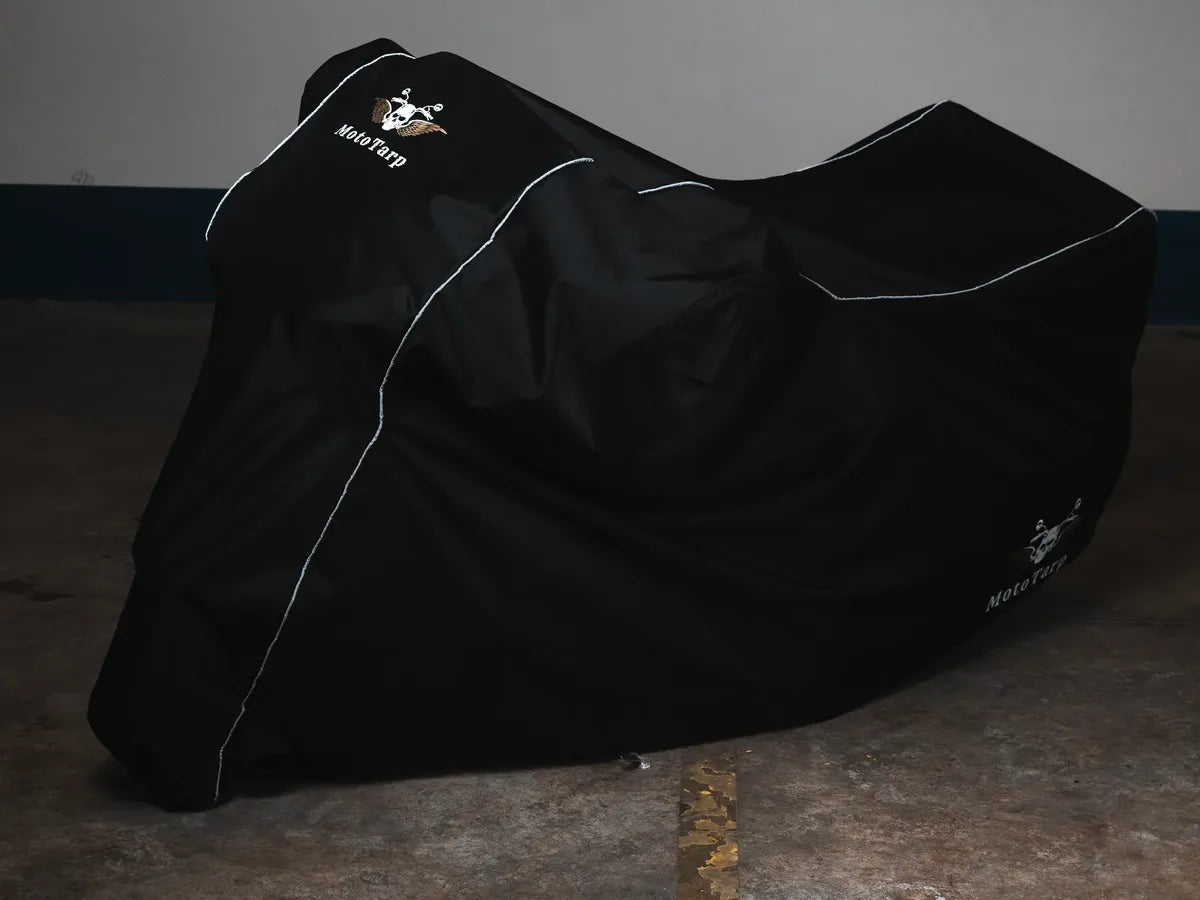
We hold our own product to the same list. The MotoTarp® Heavy-Duty Motorcycle Cover, in factory-spec terms:
- Fabric: matte black 600D polyester, 220 g/m² fabric weight.
- Water: PVC coating inside, splash-repellent coating outside, 10,000 mm water-pressure rating for the coated fabric. Water-resistant. It is a coated cover, so cover a dry bike and air it out after long wet spells.
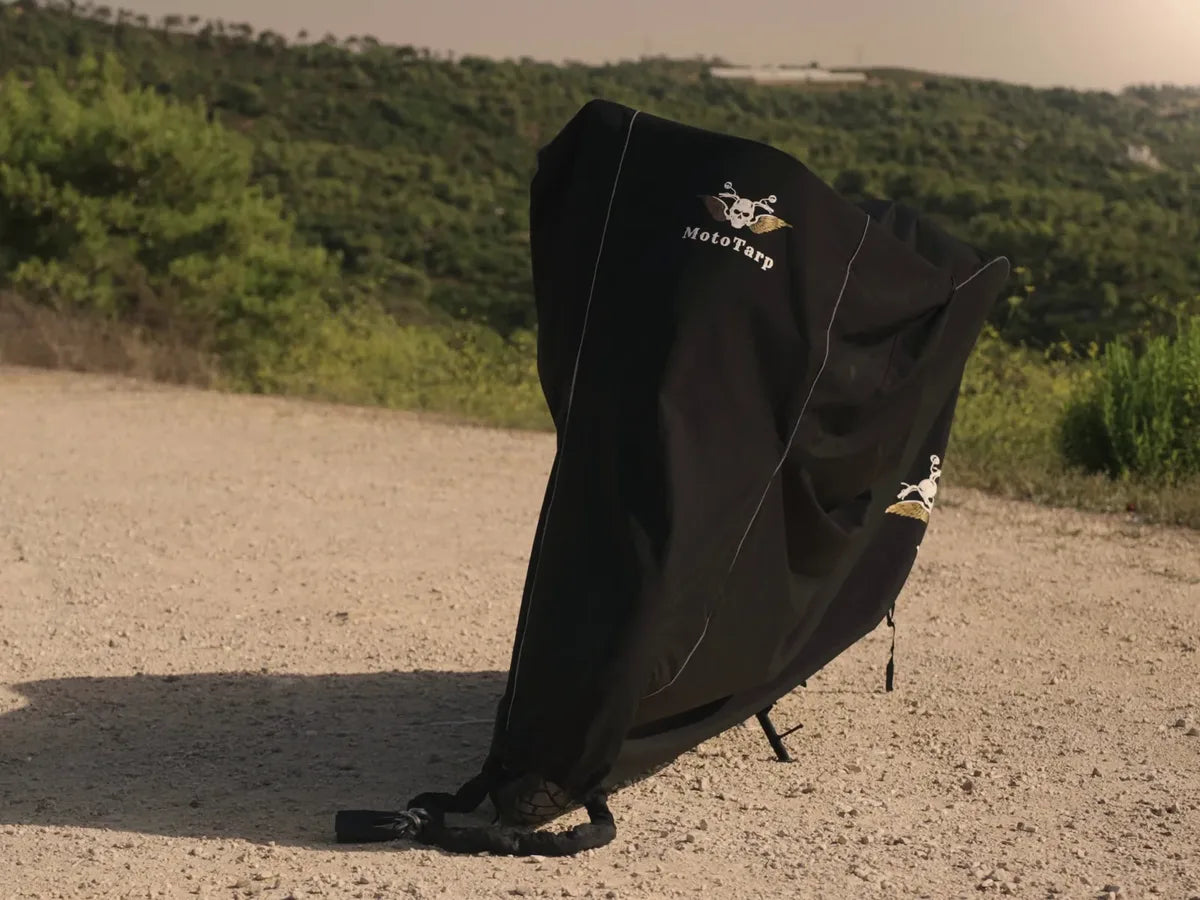
- Hold-down: straps that clip under the bike, elastic at the front and rear hems.
- Heat: heat-protection panels sewn in low on both sides. We do not publish a temperature rating, so let the exhaust cool before covering.
- Security: an opening for a disc lock or chain.
- Storage: a bag with a two-way zipper, two pullers and two reinforced handles.
- Fit: six sizes, Large to 6XL/Trike. Pick yours with the fit finder or the size guide; between two sizes, take the larger one.
Quick answers
What should I look for when buying a motorcycle cover?
Fit for your bike as equipped, straps that clip under the bike, a stated water-pressure rating, a stated denier and fabric weight, a heat-resistant panel and a lock opening.
What is a red flag on a motorcycle cover listing?
"Waterproof" or "heavy-duty" with no numbers behind them, "fits most bikes" sizing, and no way of holding the cover down under the bike.
Is denier or water rating more important?
Neither beats fit. Of the two, the water-pressure rating tells you more about rain protection, and denier and fabric weight tell you more about how the cover will stand up to wear.
Do I need a lock opening on a motorcycle cover?
If the bike is parked anywhere public, yes. It lets a disc lock or chain run through the cover so the cover cannot be lifted off without unlocking it.
Can I use a tarp instead of a motorcycle cover?
No. A plastic tarp traps moisture against the bike, has nothing to hold it down, and flaps grit across the paint.