What Does 600D Mean? Motorcycle Cover Fabric Explained
600D means the yarn in the fabric is 600 denier: 9,000 meters of that yarn weighs 600 grams. Denier measures how thick and heavy the yarn is, not how heavy, strong or water-resistant the finished fabric is. Two "600D" covers can differ a great deal depending on the fiber (polyester or nylon), the weave, the fabric weight per square meter and, above all, the coating.
That makes "600D" a starting point, not a verdict. Here is what the number tells you, what it leaves out, and how to read the rest of a cover's fabric spec.
What does denier mean?
Denier is a unit of linear density for fibers and yarns: the mass in grams of 9,000 meters of the yarn. That is the definition used in textile measurement, as summarized in the units of textile measurement reference. A 600-denier yarn weighs 600 g per 9,000 m; a 300-denier yarn of the same fiber weighs half that and is finer.
Three points that are often missed:
- Denier is about the yarn, not the cloth. It is weight per length of a thread, not weight per area of fabric.
- Denier is only comparable within the same fiber. Because fibers have different densities, a 600-denier polyester yarn and a 600-denier nylon yarn weigh the same per length but are not identical in thickness or strength.
- A yarn can be a bundle. Denier can describe a single filament ("denier per filament") or the whole yarn. On cover spec sheets, "600D" refers to the yarn.
You may also see the metric unit tex (grams per 1,000 m) or dtex (grams per 10,000 m). 600 denier is about 667 dtex.
Is a higher denier always better for a motorcycle cover?
Higher denier generally means a thicker yarn, and in the same fiber and weave a thicker yarn usually gives a tougher, more abrasion-resistant fabric. That is why outdoor covers tend to use mid-to-high denier polyester rather than the fine fabrics used for indoor dust covers.
But "higher is better" breaks down quickly:
- A heavier yarn makes a heavier, bulkier cover that is harder to fold and carry. If it is a chore to put on, it stays in the bag.
- Denier says nothing about how tightly the yarns are woven. A loosely woven high-denier fabric can be weaker in practice than a tightly woven lower-denier one.
- Denier says nothing about the coating, and on an outdoor cover the coating does most of the water-resistance work. See what a water rating in mm means.
Use denier to compare covers made of the same fiber, then look at fabric weight, coating and construction before deciding.
What is the difference between denier and fabric weight (g/m²)?
Denier is the weight of a length of yarn. Fabric weight, or mass per unit area, is the weight of a piece of the finished cloth, usually given in grams per square meter (g/m², sometimes written gsm) or ounces per square yard (oz/yd²). In the US, ASTM D3776 sets the test methods for mass per unit area of fabric.
| Denier (D) | Fabric weight | |
|---|---|---|
| Measures | Yarn: grams per 9,000 m | Cloth: grams per square meter, or oz per square yard |
| Includes the coating? | No | Depends on how it is stated; a coated weight includes it, a base-cloth weight does not |
| Tells you about | Yarn thickness and, within one fiber, toughness | How much material is in the cloth overall |
| Missing | Weave density, coating, fiber choice | Fiber choice, yarn size, coating quality |
Spec sheets are not always clear about which weight they mean. "Fabric weight" might be the base cloth, the coated cloth, or a figure per square meter, per linear meter of a roll, or per yard. If you are comparing covers on weight, ask how the figure is stated. For our own cover we give the factory's wording as is: 220 g fabric weight, as stated on the factory spec. The spec does not say per what (square meter, linear meter or yard), so we have not converted it to g/m² or oz/yd².
Polyester, nylon or polypropylene: which fabric is best for a motorcycle cover?
The three fibers you will meet on cover listings behave quite differently.
| Fiber | How it is used in covers | Melting point (approx.) | Moisture regain* | Key trade-offs |
|---|---|---|---|---|
| Polyester (PET) | Woven fabric, usually coated; common in outdoor covers | About 250–260 °C (482–500 °F) (source) | 0.4–0.8% (source) | Takes up very little water from the air |
| Nylon (polyamide) | Woven fabric, often coated | Nylon 6 about 215–220 °C; nylon 6,6 about 264 °C (source, source) | Nylon 6: 2.8–5.0%; nylon 6,6: 4.0–4.5% (source) | Strong for its weight; takes up several times more water than polyester |
| Polypropylene (PP) non-woven | Bonded sheet rather than woven yarn; common in light and budget covers | Commercial grades about 160–166 °C (320–331 °F) (source) | Not listed | Light and cheap; degrades in sunlight unless stabilized; lowest melting point of the three |
*Moisture regain is the amount of water a dry fiber takes up from the air under standard conditions, as a percentage of its dry weight.
A few notes on each:
Polyester is a common choice for outdoor covers. It takes up very little water from the air, and its melting point is among the highest of the common cover fibers.
Nylon is strong for its weight and makes light, packable covers. It takes up noticeably more water than polyester, which is worth knowing for a cover that spends weeks in wet weather.
Polypropylene non-woven is a different kind of material. A non-woven fabric is a sheet of fibers or filaments bonded together mechanically, thermally or chemically, rather than woven or knitted from yarn, as the nonwovens industry association INDA defines it. Because it is not woven from yarn, a yarn rating like "600D" does not describe it in the same way. Polypropylene is vulnerable to ultraviolet light: outdoors, unprotected PP shows degradation as cracks and crazing, which is why it needs UV stabilizers added (source). Non-woven PP has its place under a roof; for a bike living outside, ask what the maker says about UV stabilization.
The melting points matter for one practical reason: a hot exhaust is one of the quickest ways to ruin a cover. Read can you put a cover on a hot motorcycle before you cover a bike that has just been ridden.
What do coatings on a motorcycle cover do?
On an outdoor cover the base fabric provides strength and shape; the coating does most of the job of keeping water out. Coatings sit on one face of the fabric or both, and they fall into two broad roles:
- A barrier coating, usually on the inside face, such as polyurethane (PU) or polyvinyl chloride (PVC). This is the layer that gives the fabric its hydrostatic head rating.
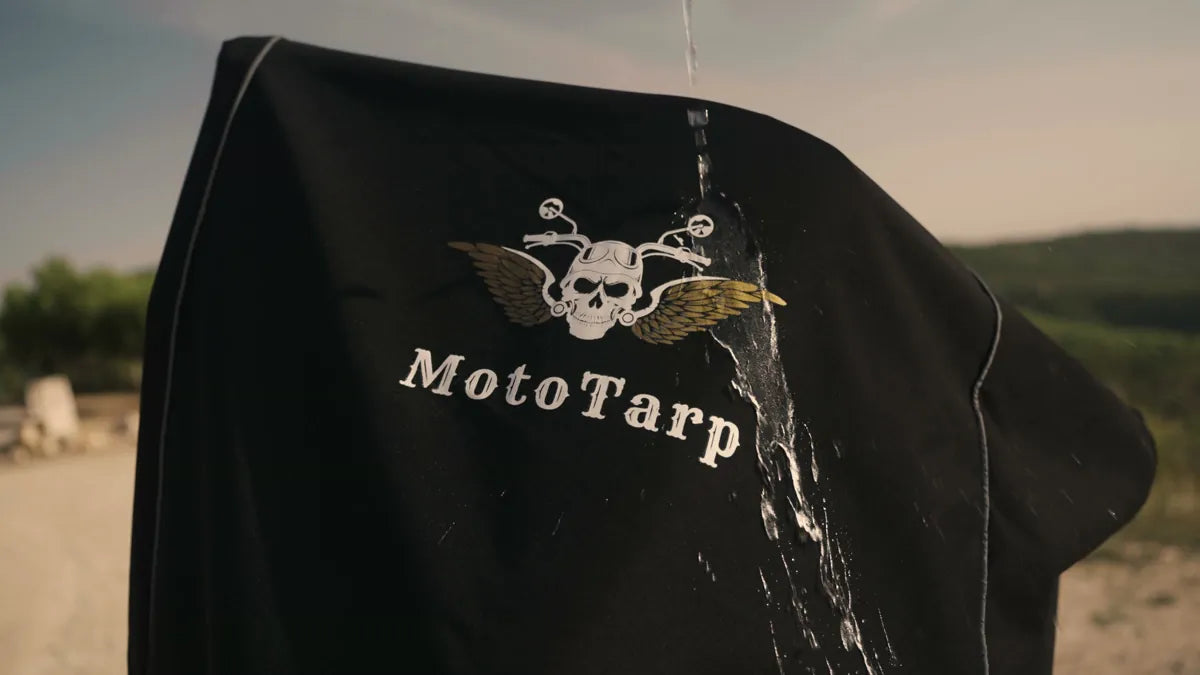
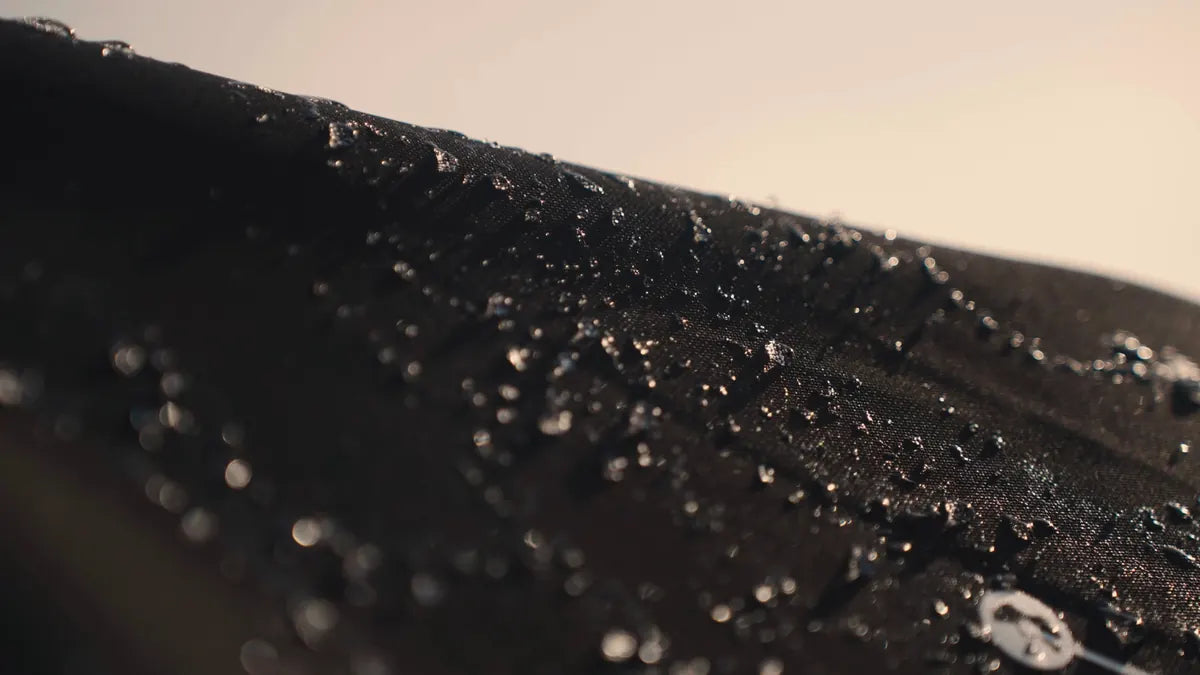
- A repellent finish on the outside face, which makes water bead and run off instead of soaking into the outer yarns. It helps the cover shed water and dry faster, and it wears with time and washing.
Coatings also change how the fabric handles heat. PVC, for example, has a maximum operating temperature of around 60 °C (140 °F) before heat distortion begins, according to the polyvinyl chloride reference. That is far below the melting point of the polyester underneath, and far below exhaust temperatures. It is one more reason to let the bike cool before covering it.
Coatings that hold liquid water out can also slow water vapor on its way out, which is why breathability is a separate question with separate tests.
What fabric is the MotoTarp® cover made of?
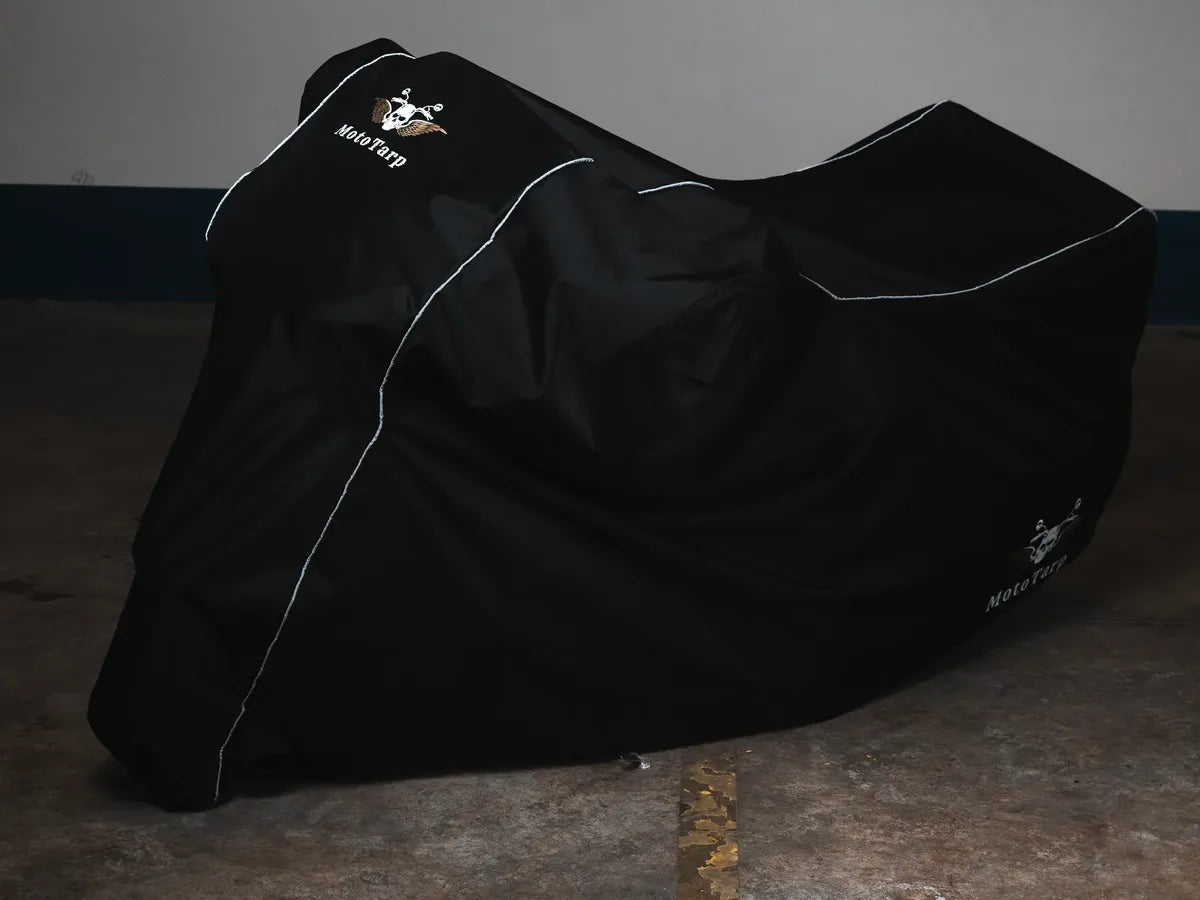
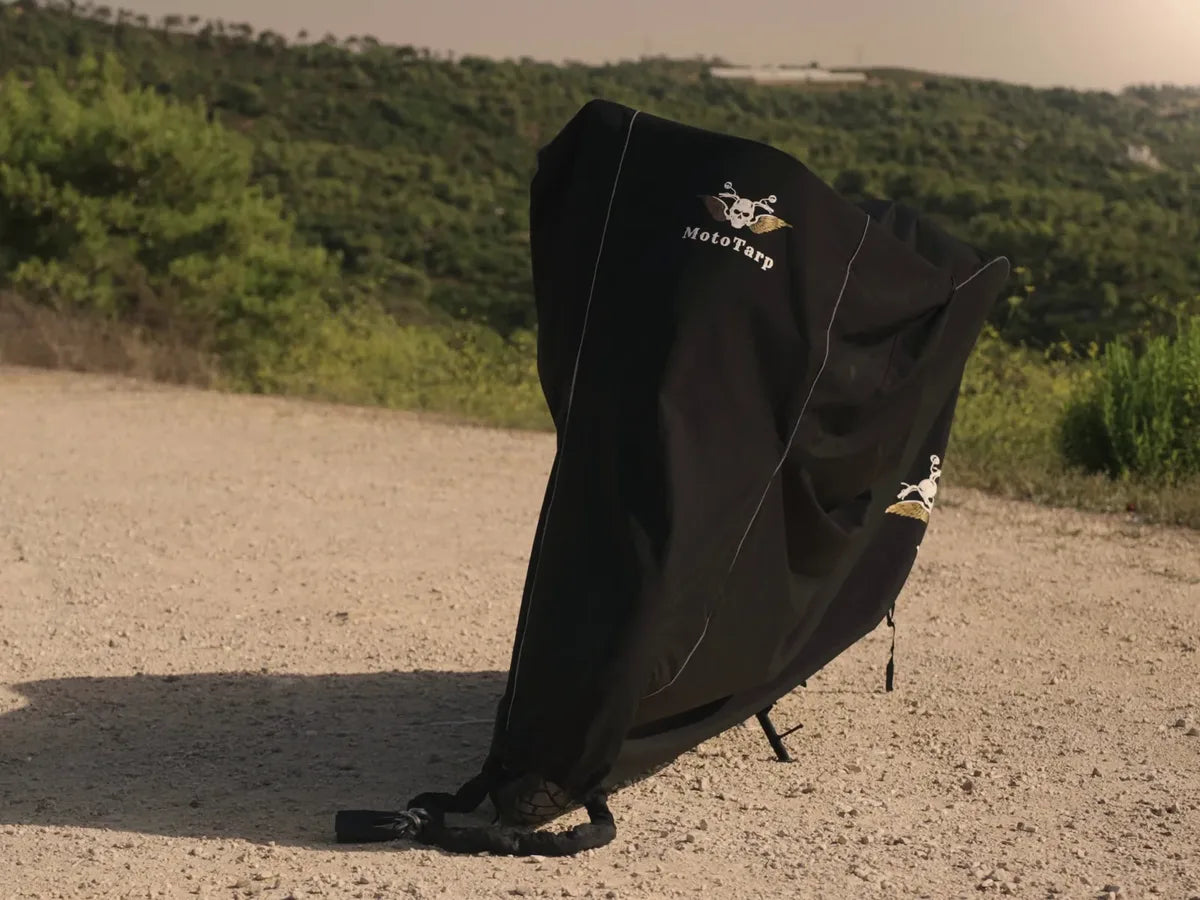
The MotoTarp® Heavy-Duty Cover is 600D polyester in matte black, with a 220 g fabric weight (factory spec, as stated by the factory). It has a PVC coating on the inside and a splash-repellent coating on the outside, and the coated fabric carries a 10,000 mm water-pressure rating. We describe it as water-resistant.
How should you read a cover's fabric spec?
In this order:
- Fiber. Polyester, nylon or polypropylene non-woven. This sets the baseline for water uptake, heat and sunlight.
- Denier. Compare only within the same fiber.
- Fabric weight. Ask what it includes and what basis it uses.
- Coating. What it is, which side it is on, and whether there is a stated hydrostatic head with a method.
- Construction. Seams, hems, straps and openings decide how the fabric performs on an actual bike in wind.
- Fit. The best fabric fails if it flaps. See how to choose a motorcycle cover and the buyer's checklist.
Quick answers
What does 600D mean?
600D means 600 denier: 9,000 meters of the yarn used in the fabric weighs 600 grams. It describes yarn thickness, not fabric weight, strength or water resistance on its own.
Is 600D polyester good for a motorcycle cover?
600D polyester is a common, sturdy base fabric for outdoor covers, and polyester takes up very little water. How well the cover performs still depends on the coating, the seams, the fit and how it is held down.
Is denier the same as fabric weight?
No. Denier is the weight of a length of yarn (grams per 9,000 m). Fabric weight is the weight of an area of cloth, usually in g/m² or oz/yd², and may or may not include the coating.
Is 300D or 600D better?
In the same fiber and weave, a 600D fabric uses yarn twice as heavy as 300D and is usually tougher, but heavier and bulkier. Compare coating and construction too before deciding.
Polyester or nylon for a motorcycle cover?
Polyester absorbs much less water (moisture regain about 0.4–0.8%, against roughly 3–5% for nylon), so it holds its shape better when wet. Nylon is strong and light. Both depend on their coating for water resistance.
Are non-woven polypropylene covers OK outside?
They are light and inexpensive, but polypropylene degrades in sunlight unless UV stabilizers are added, and it has the lowest melting point of the common cover fibers. They suit covered parking better than full outdoor exposure.
Where MotoTarp® fits
If you want a 600D polyester cover for a bike that lives outside, the MotoTarp® Heavy-Duty Cover pairs that fabric with a PVC inner coating, a splash-repellent outer coating, elastic front and rear hems, straps that clip under the bike and a lock opening for a disc lock or chain. It comes in six sizes from Large to 6XL/Trike; the fit finder picks the size for your bike.
Related: Indoor vs outdoor motorcycle covers · What actually damages a motorcycle parked outside · How to stop a motorcycle cover blowing off