Motorcycle Cover Water Ratings Explained: What 3,000 mm or 10,000 mm Actually Means
A water rating in millimeters on a motorcycle cover is a hydrostatic head figure: the height of a column of water, in mm, that a sample of the fabric held back in a lab before water came through. A higher number means the coated fabric resists more water pressure. It does not tell you how the seams, zippers or openings behave, how the fabric will perform after a few seasons of sun and folding, or whether the cover lets moisture out from underneath.
So the number is useful, but only as one line on a spec sheet. Here is how it is measured, what it means in practice, and why moisture from below matters as much as rain from above.
What does the mm water rating on a motorcycle cover mean?
Hydrostatic head is the water pressure a fabric withstands before water penetrates it, expressed as the height of a water column. A rating of 3,000 mm means the fabric resisted the pressure at the bottom of a 3-meter column of water during the test.
You will see the same idea written several ways, and they are interchangeable:
| Written as | What it means | Converts to |
|---|---|---|
| mm or mm H2O | Millimeters of water column | 10 mm = 1 cm H2O |
| cm H2O | Centimeters of water column, the unit most test standards report | 1 cm H2O ≈ 0.98 mbar |
| mbar | Millibars of pressure | 1 mbar ≈ 1.02 cm H2O |
| Pa or kPa | Pascals, the SI unit of pressure | 1 mm H2O ≈ 9.81 Pa |
For a sense of scale: 10,000 mm of water column works out to roughly 98 kPa, or a little over 14 psi. Those conversions are arithmetic, not a performance claim.
How is a fabric's water rating measured?
The most widely cited method is ISO 811, the hydrostatic pressure test for textiles. The American textile chemists' association publishes a similar method, AATCC TM127. Under ISO 811:
- A sample of fabric is clamped so that an area of 100 cm² (about 15.5 square inches) faces water.
- Water pressure on one side rises at a fixed rate: either 10 cm H2O per minute or 60 cm H2O per minute. The standard notes that results at different rates may not be the same.
- The water is held at either 20 °C or 27 °C (68 °F or about 81 °F), and the standard notes that the warmer water gives lower results.
- The test stops when water has come through the fabric in three places, and the pressure at the third drop is recorded. Parties can agree to report the first drop instead, which gives a lower figure.
- Areas with deep creases or fold marks are not tested.
Two things follow. A figure without its method is incomplete: rate, water temperature and first-or-third drop all change the number. And the test is done on a flat, uncreased piece of fabric. The standard itself says the result is directly relevant to fabric articles under water pressure "for short or moderate periods of time." It is a measurement of the material, not of the finished cover.
What do the numbers mean in practice?
No standard we know of sets bands for motorcycle covers, so treat any "good / better / best" chart you see online with caution, including ones that look official. What you can say with confidence:
- A higher hydrostatic head means the coated fabric resists more pressure before it leaks. Comparing two covers tested the same way, the higher number is the more water-resistant fabric.
- Pressure builds where water sits: in a sag between the seat and a top box, a fold over the tank, or a puddle on a slack panel. A well-fitted cover that sheds water asks less of its fabric.
- Past a point, the fabric stops being the weak link. Water gets in through the hem in wind-driven rain, stitch holes, openings and worn spots, and a higher fabric rating does nothing about those.
- Coatings age. The rating describes the fabric when tested; sun, folding and grit wear coatings over time, and the test does not predict how fast.
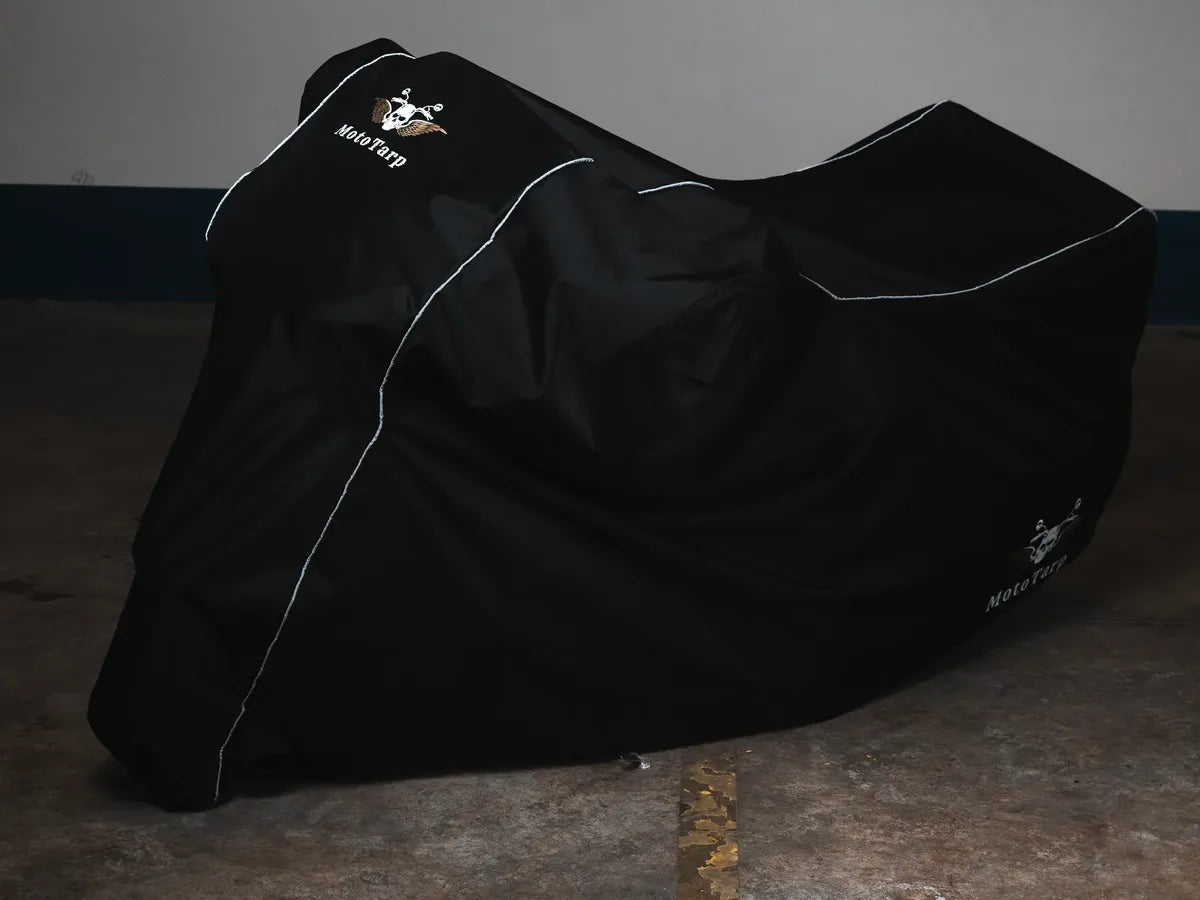
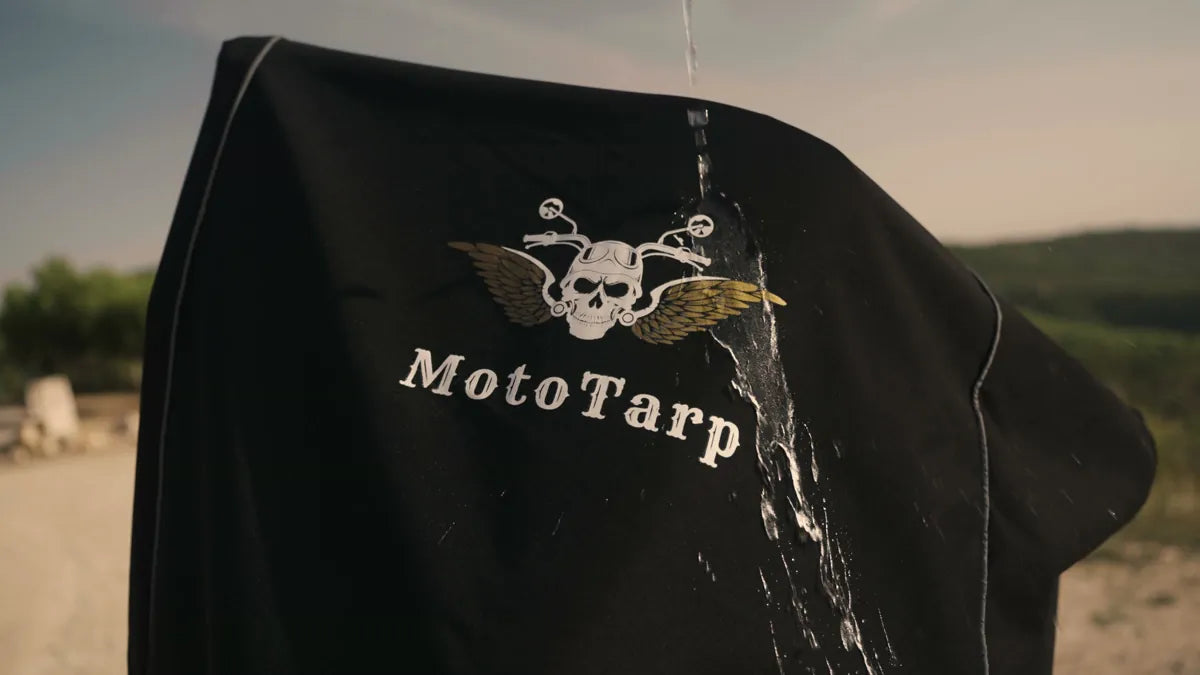
For reference, the MotoTarp® Heavy-Duty Cover is described as water-resistant, with a 10,000 mm water-pressure rating for the coated fabric. The fabric is 600D polyester with a PVC coating on the inside and a splash-repellent coating on the outside. As above, that figure describes the coated fabric, not every seam and opening of the finished cover.
Why is "waterproof" so vague on motorcycle covers?
Because the word on its own carries no number, no method and no statement about the seams. A cover sold as "waterproof" might use a fabric tested to a high hydrostatic head, a low one, or none at all. And since water usually gets under a cover through its construction, even a high-rated fabric can make a cover that lets water in.
When you see the word, ask four questions:
- Is there a number? A hydrostatic head figure in mm, cm H2O or mbar.
- Is there a method? ISO 811, AATCC TM127 or similar.
- What about the seams? Stitching puts holes through coated fabric. Taped or sealed seams are a separate construction detail, and a fabric rating says nothing about them.
- How does the cover close at the bottom? Elastic hems and straps under the bike matter for wind-driven rain, which comes in sideways and from below.
Does a higher water rating mean a drier bike?
Not necessarily, because rain is only half of the water problem. The other half comes from underneath.
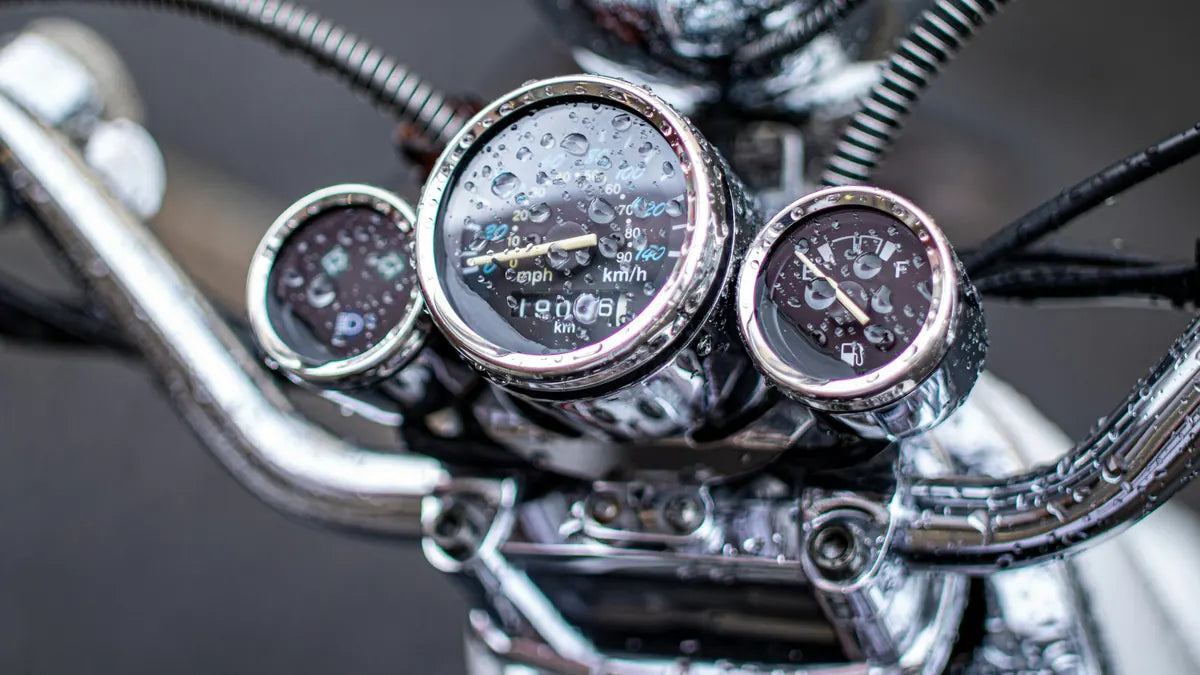
A parked motorcycle sits over damp ground and in humid air. The dew point is the temperature the air must cool to before it reaches 100% relative humidity, as the National Weather Service defines it; cool a surface below it and water vapor condenses on that surface as liquid. At night the cover and the metal of the bike cool, and if they drop below the dew point of the air trapped underneath, water forms on the inside of the cover and on the bike.
If the cover holds vapor in, that water stays. A wet tank in the morning is often condensation, not a leak. The full mechanism is in what actually damages a motorcycle parked outside.
How is breathability measured, and why does it matter?
A breathable fabric is one that lets water vapor pass through it while blocking liquid water. It is measured with entirely different tests from the hydrostatic head:
| Property | What it measures | Typical units | Common methods |
|---|---|---|---|
| Water resistance (hydrostatic head) | Liquid water pressure before leaking | mm or cm H2O, mbar | ISO 811, AATCC TM127 |
| Moisture vapor transmission (MVTR) | How much vapor passes through per area per day | g/m²/24 h | ASTM E96 (cup methods), JIS L 1099 |
| Evaporative resistance (RET) | Resistance to vapor passing through; lower is more breathable | RET value | ISO 11092 (sweating hot plate) |
As the overview of breathability testing on Wikipedia notes, these vapor methods do not correlate with each other, so an MVTR figure from one method cannot be compared with one from another.
The practical point: a cover's mm rating tells you nothing about breathability. If a maker publishes a breathability figure, it will have its own units and method; if none is published, do not assume one. MotoTarp® does not publish a breathability figure for its cover.
How do you keep the bike dry under any cover?
These habits matter more than the last thousand millimeters of hydrostatic head:
- Cover a dry bike. A bike covered wet stays wet.
- Cover a cool bike. Hot exhaust and coated fabric do not mix; see can you put a cover on a hot motorcycle.
- Avoid sags. Snug the hems and straps so water runs off instead of pooling.
- Lift a corner after humid nights and check the tank for condensation; air the bike on dry days.
- Keep it on. A cover that blows off in a storm protects nothing; see how to stop a motorcycle cover blowing off.
For the fabric side of the spec sheet, including what "600D" does and does not tell you, read what 600D means on a motorcycle cover. For the whole checklist, see the motorcycle cover buyer's checklist and how to choose a motorcycle cover.
Quick answers
What does 10,000 mm mean on a motorcycle cover?
It means the coated fabric resisted the pressure of a 10,000 mm (10-meter) column of water in a hydrostatic head test before water came through. That is roughly 98 kPa or a little over 14 psi. It describes the fabric, not the seams or openings of the finished cover.
How is hydrostatic head tested?
Under ISO 811, a 100 cm² sample is clamped and water pressure on one side rises at a fixed rate until water appears in three places. The pressure at the third drop is the result. The rate, water temperature and drop counted all affect the number.
Is a higher mm rating always better?
Higher means the fabric resists more water pressure, when both covers were tested the same way. Past a point, the fabric is no longer where water gets in: seams, hems, openings and wear matter more.
Does "waterproof" on a cover mean anything?
Not on its own. Look for a hydrostatic head number, the test method, and how the seams and hem are built. Without those, the word is a description, not a specification.
Why is my bike wet under the cover when it didn't leak?
Usually condensation. Moisture from the ground, the bike and the air condenses on cool surfaces overnight when they drop below the dew point. Cover the bike dry, park off wet ground and air it on dry days.
Is a water rating the same as breathability?
No. The water rating measures liquid water pressure; breathability measures water vapor passing through, with different tests and units (g/m²/24 h or RET). A cover's mm figure says nothing about breathability.
Where MotoTarp® fits
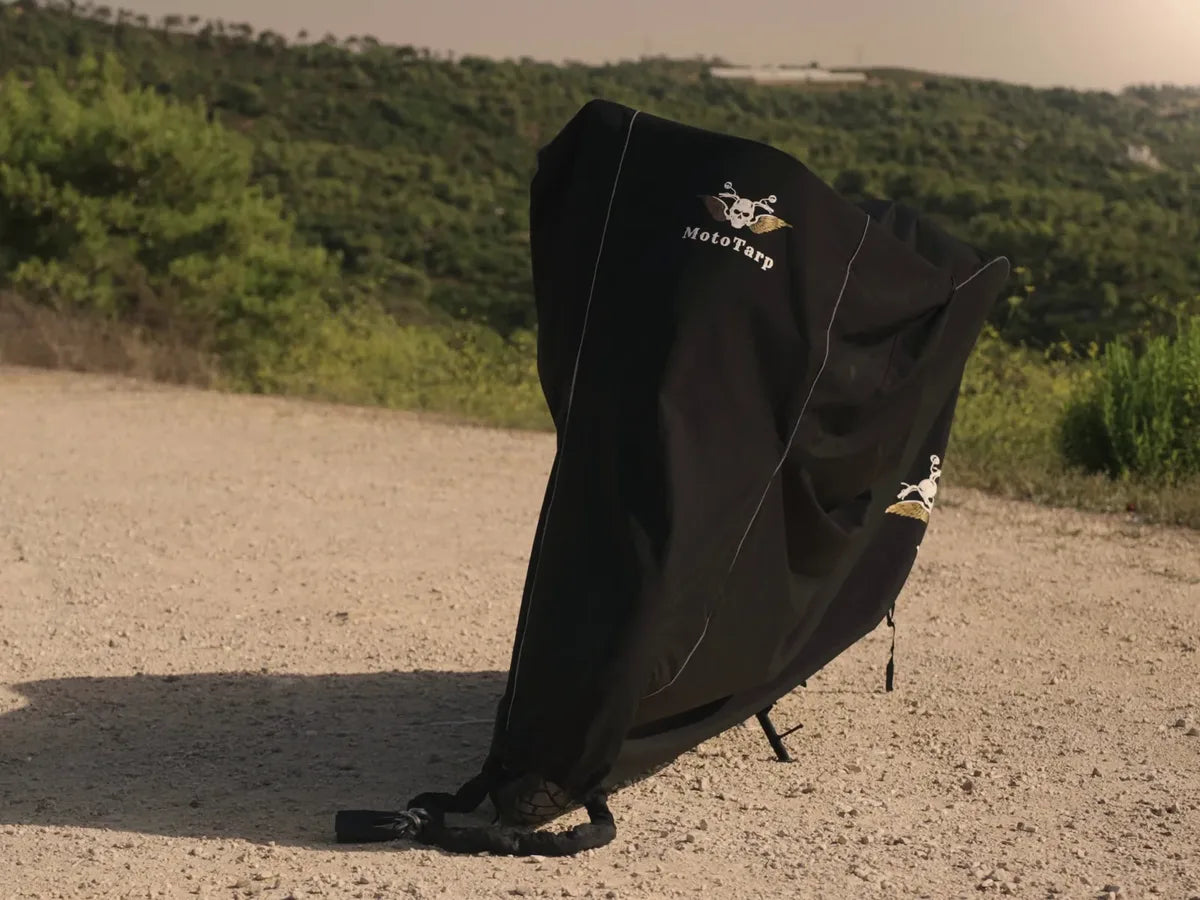
The MotoTarp® Heavy-Duty Cover is matte black 600D polyester with a PVC coating inside, a splash-repellent coating outside and a 10,000 mm water-pressure rating, with elastic front and rear hems and straps that clip under the bike. It comes in six sizes, from Large to 6XL/Trike. Use the fit finder to pick the size for your bike as you ride it.
Related: Indoor vs outdoor motorcycle covers · How to store a motorcycle outside for winter · Motorcycle cover vs garage vs carport