Protecting Your Bike on a Road Trip: Hotels, Campsites and Overnight Stops

On a road trip, park where the bike is lit, in a camera's actual field of view and visible from your room, never by the exit or in the dark corner. Take the helmet and every unattached bag inside. Lock a disc lock and a light chain to something fixed, then cover the bike so nobody can price it.
Most riders plan a tour in enormous detail and plan the parking not at all. The route is drawn, the passes are chosen, the mileage worked out to the hour, and then every night for a week the bike sits somewhere unfamiliar, loaded with everything you own, while you are asleep two floors up and cannot see it. That is the highest-risk repeated moment of any trip, and it is largely solvable with decisions you make before you leave and a two-minute routine when you arrive.
Why is a bike more vulnerable on a road trip than at home?
Away from home you lose everything that normally protects the bike. There is no garage, no ground anchor, no chain heavy enough to matter, no familiar neighbors, and no idea which corner of the lot is the dark one. You are somewhere new every night, so you never learn a place's weak spots before you have already left. And the bike is carrying luggage, which advertises two things at once: that it is worth something, and that its owner is asleep nearby and not coming back out until morning.
You cannot fix that with hardware. You fix it with where you park, what you take off the bike, and what you carry, in roughly that order of importance.
Where should you park a motorcycle at a hotel?
Park under a light, inside a camera's real field of view, and where you can see the bike from your room window. Book with the bike in mind and half the problem disappears before you arrive.
Things worth asking when you reserve, all of which are normal requests hotel staff hear from riders regularly:
- Is there covered parking, a courtyard, or an awning? Ask specifically, because "we have parking" and "we have covered parking" are very different answers.
- Is the lot covered by cameras, and where do they actually point? Front-desk staff usually know.
- Can the bike go near the entrance, under the lights, or in view of reception? Many places will say yes to a motorcycle when they would not to a car, because it fits in spaces a car cannot.
- Is there a ground-floor room facing the lot? Being able to see the bike from the window is worth more than any lock you can carry.
On the road in North America, exterior-corridor motels are often better for a bike than interior-corridor hotels. You park directly outside your own door, the bike is a few feet away rather than in a shared lot around the back, and you can look at it without getting dressed. It is one of the few situations where the older, cheaper option is genuinely the safer one.
When you arrive, walk the lot before you choose the space. Three rules:
- Park in a camera's actual field of view. Look at where the lens is aimed, not where the housing is mounted.
- Park under a light and where people walk past. Visibility is free security.
- Do not park by the exit or in the far corner. The space closest to the road is the easiest place in any parking lot to back a van up to and load unobserved; the far corner is where nobody looks.
One practical extra that has nothing to do with theft: if the ground is asphalt and the day has been hot, put something under the sidestand. A loaded touring bike will sink its stand into softened asphalt overnight and go over sideways, and that is a genuinely common way to lose a mirror, a lever and a fairing panel. A kickstand puck weighs almost nothing; a flattened drink can works in an emergency.
What should you take off the bike overnight?
The working rule is simple and worth following even when you are tired:
Anything not physically attached to the bike comes to the room. Anything attached is locked, and then covered.
Helmet, gloves, jacket and any tank bag go inside with you, every night, without exception. A helmet left on a mirror overnight is gone or ruined, and a helmet you cannot trust is a helmet you have to replace before you can ride home.
Be honest about what your luggage actually is. Soft luggage is cut open with a pocket knife in seconds. Hard cases are pried open, and many use a common key pattern across a whole manufacturer's range. Panniers and top boxes are weatherproof storage, not safes. They stop things falling out and getting wet, and that is the job they do well. Anything you would be genuinely upset to lose (documents, passport, spare keys, laptop, camera, medication) goes in the room, in the one bag you can carry in a single trip.
Two habits that cost nothing: never leave the bike's spare key on the bike, and photograph the loaded bike on day one. If something does happen, you have an image of exactly what was fitted and where.
What motorcycle security is worth carrying on a road trip?
Everything you carry is paid for in weight and packed volume, and on a bike both are scarce. That produces one honest conclusion worth stating before the list: the security you actually carry beats the security you left at home because it was heavy. A compact disc lock used every night is worth more than a heavy chain sitting in your garage.
What earns its weight:
- A compact disc lock. Light, small, visible, quick. It removes your bike from the list of easy ones. Use the reminder cable; you are tired and in an unfamiliar place, which is exactly when people ride off with a disc lock fitted.
- A light cable or chain that reaches something fixed. It will not survive a determined attack with tools, but it does stop the bike being pushed away, wheeled around a corner or lifted by two people without tools, which is a real class of theft. Route it through the frame, not just a wheel, and get it around a structural post, a railing, or another bike whose owner has agreed.
- A cover. See below.
- A tracker, if you already run one at home. It changes nothing about the night and everything about the following week.
What is usually not worth its weight: a heavy security chain, a ground anchor, or a disc lock plus an alarmed disc lock plus a cable. Pick a kit you will still be willing to deploy on night six, in the rain, after 400 miles.
For the full picture of what each layer defeats, and what none of them do, see motorcycle theft prevention: what actually slows a thief down.
Should you cover your motorcycle overnight on a trip?
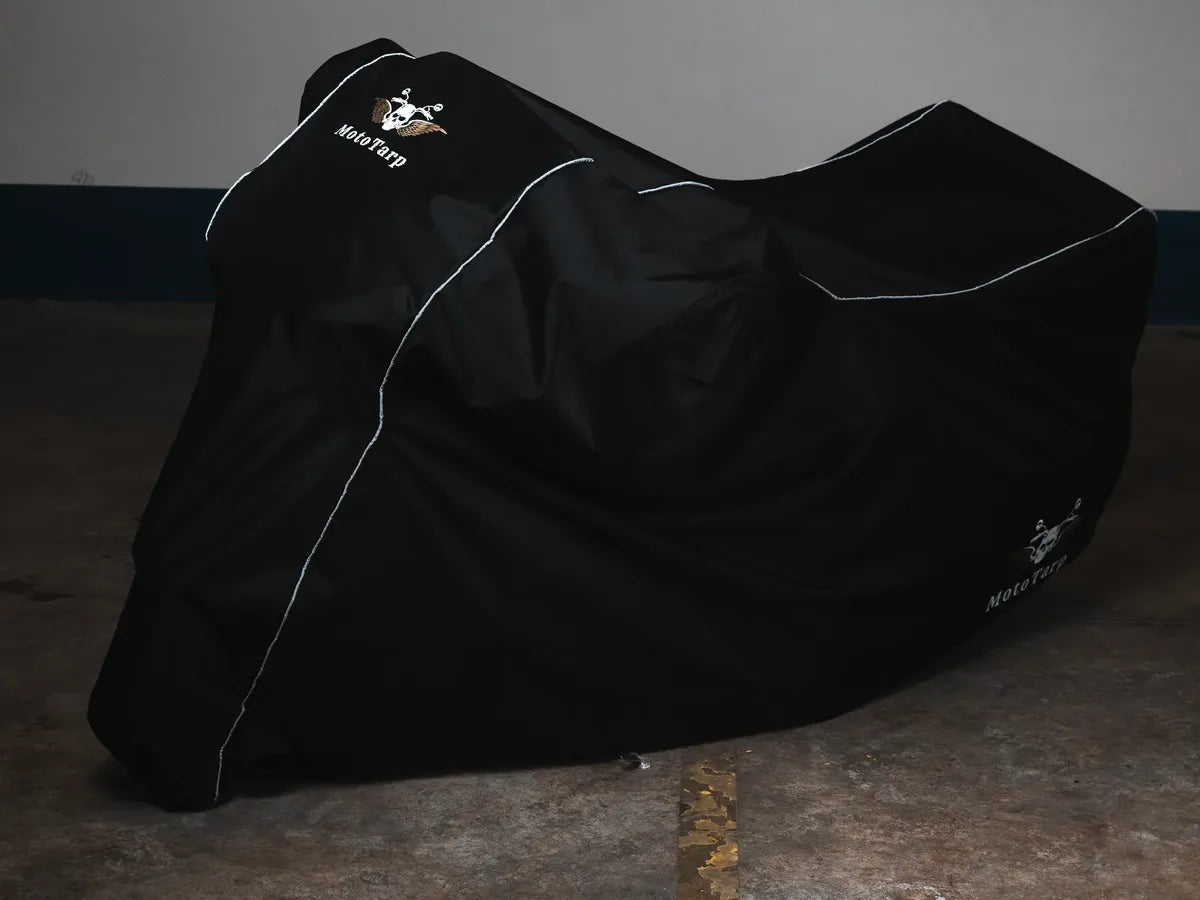
Yes, and concealment does more work away from home than anywhere else. The reason is specific. A loaded touring bike parked outside a motel is a legible object: it names the make, the model, the luggage, roughly the value, and the fact that its owner is inside asleep. Covered, it is a shape. Nobody walking through the lot can price it, and nobody driving past can shop from it.
Be clear about the limit, though: a cover stops your bike being chosen. It does nothing to slow down someone who has already chosen it, and it hides a person working underneath it just as well as it hides the bike. It is a layer in a stack, never a substitute for a lock.
Four practical things nobody mentions:
Fitting a cover over luggage is a sizing problem. This is what riders get wrong most often. A cover bought for your bike will not necessarily go over your bike plus panniers plus a top box plus a roll bag, and a cover stretched drum-tight over a top box tears at the seam and lets water pool. Size for the bike as you actually tour with it (luggage on, screen up), not for the naked bike. For the MotoTarp® Heavy-Duty Cover, the size guide and the fit finder are the things to check before a trip, not after.
Never put a cover on a hot exhaust. On tour this matters more than at home. At home you park and leave the bike for hours before covering it. On a trip you arrive after 300 miles, want to check in and eat, and the headers and silencer are at their hottest exactly then. Either give it fifteen or twenty minutes while you unload and check in, or use a cover with a heat-shield panel at the exhaust: a reinforced heat-resistant section positioned where the fabric meets the hottest part of the bike. This is the single situation on a tour where a cover without one will melt.
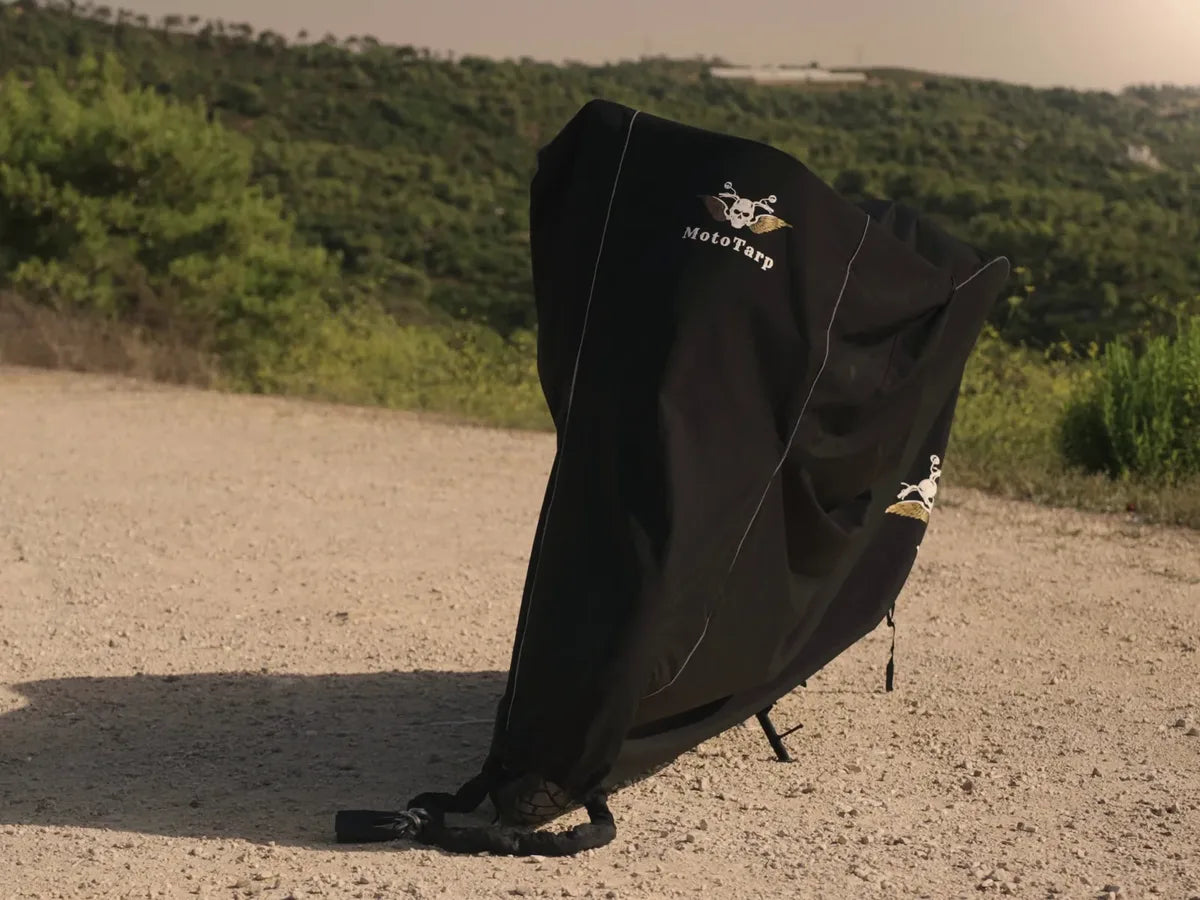
Anchor it or lose it. A motel lot at 2am with wind across it will lift a loose cover clean off, and you will find it in a hedge or not at all. Straps, an under-bike buckle system and elastic hems are what keep a cover on. If your cover has a lock opening, run the disc lock through it so the cover is secured to the bike rather than sitting on it.
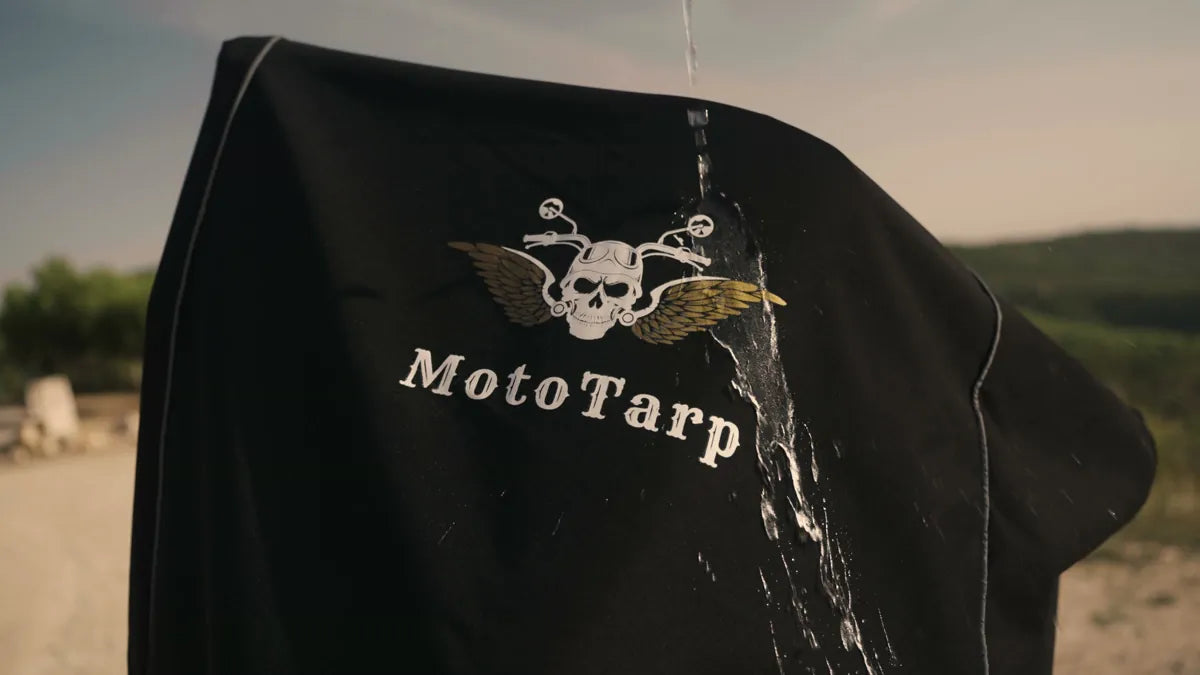
Deal with the wet cover in the morning. It will be soaked in dew even when it has not rained. Shake it out, roll it with the wet side inward, and pack it where it is not against your dry clothes: a mesh pocket, its own dry bag, or bungeed on the outside for the first hour of riding, where it will dry at 60 mph. What you must not do is stuff it damp into a pannier for six days.
How do you keep a motorcycle safe at a campsite or a rally?
They are two different problems and worth separating.
At a normal campsite the threat is mostly opportunistic and the environment is on your side. Park where you can see the bike from inside the tent, ideally beside the entrance so it is between you and the path. Use the disc lock. And understand that tent stakes and guy lines are not anchors. A bike chained to a tent is a bike chained to a bag of nylon, and pretending otherwise is worse than not bothering, because it feels like security. Chain to a tree, a post, a fixed picnic table, or another rider's bike if they agree.
Rallies and large events are a different profile entirely. Hundreds of bikes, thousands of people, no meaningful security, plenty of drinking, and enough noise that an alarm is just part of the atmosphere. Two things genuinely work: park in a cluster with people you know and agree to watch for each other, and chain to another bike so neither can be moved without the other. Group parking is the actual security measure at an event, because attention is the scarce resource, not hardware.
At both, the value of neighbors who notice is real and underrated. Say hello to the people either side of you. A camper who knows your bike is your bike is a better alarm than any device you carried there.
Which overnight stops are riskiest on a motorcycle trip?
| Overnight stop | Main risk | Best single measure | What does not work |
|---|---|---|---|
| Exterior-corridor motel | Passing traffic sees a loaded bike | Park outside your own door, lit, and cover it | Trusting the lot to be watched |
| Interior-corridor hotel, shared lot | You cannot see the bike at all | Ask for a ground-floor room facing the lot, or a spot by reception | Parking wherever the valet points |
| Hotel with an enclosed or underground garage | Low; mostly damage and drips | Lock it anyway, and mind sprinkler and drip water overhead | Assuming an access gate is security |
| Campsite | Opportunists walking through | Bike visible from inside the tent, chained to something structural | Chaining to tent stakes or guy lines |
| Rally or large event | Volume of people, no security, noise masks everything | Park in a known group; chain bikes to each other | An alarm (nobody will react to it) |
| Roadside or gas stop, daytime | Luggage theft while you are inside for five minutes | Take the tank bag with you; never leave the helmet | Leaving it "just for a minute" unlocked |
| Friend's driveway or a private yard | Low, but unfamiliar | Steering lock and disc lock, out of view of the street | Assuming a private drive is not overlooked |
Is it worth covering the bike overnight just for the weather?
Yes, and it is at least half a comfort decision. Comfort is not a small thing on day five.
A bike that sits uncovered through a wet night starts the next morning wet. The seat is wet, so you are wet within a minute of setting off. The grips and levers are wet. The screen is covered in dew that smears rather than wipes. Chain lube has been washed thin. Everything you touch in the first ten minutes is cold and damp, and the day starts badly and slowly.
Covered, none of that happens: you pull the cover off a dry seat and dry controls and go. And on the sunny end of the trip, a cover is doing something less visible. Parking a bike in full sun all day, every day, for two weeks is a meaningful dose of UV on paint, seat vinyl and unpainted plastics. See what actually damages a motorcycle parked outside for how quickly that adds up.
One caution: never cover a wet bike and leave it that way for days. Overnight is fine. A week under a cover with water trapped underneath is how corrosion starts.
Can you use a motorcycle cover on a trailer?
No. A storage cover is not a trailering cover, and ours is not either.
A cover designed to sit on a stationary bike is not built for sustained 70 mph airflow. It will flog itself to pieces within a few hundred miles, and while it is doing that, the flapping fabric with road grit trapped underneath will polish the clearcoat off your tank and side panels. The damage is worse than the damage from carrying the bike bare.
If you are trailering, use a cover specifically sold as trailerable, or carry the bike uncovered and clean it at the other end. The same logic applies to a bike on the back of a motorhome.
What should be on a pre-departure checklist?
Bike-security items only, since your packing list already covers socks.
- Photograph the loaded bike, plus the VIN, plate and insurance details, stored on your phone
- Disc lock packed, with the reminder cable
- Light chain or cable packed, long enough to reach a post
- Cover packed, sized against the bike with the luggage fitted
- Tracker fitted, charged and tested before you leave, hidden somewhere non-obvious
- Kickstand puck in a pocket you can reach without unpacking
- Spare key carried on you, never left on the bike
- Insurance and breakdown documents saved offline on your phone, not just in email
- Hotel bookings checked for parking, and the first night's parking situation confirmed
Ten minutes before you leave, and it removes the entire category of decision you would otherwise be making at 9pm in an unfamiliar parking lot.
Quick answers
Where should you park a motorcycle at a hotel overnight?
Under a light, inside a camera's actual field of view, and where you can see it from your room window. Avoid the far dark corner and the space nearest the exit, which is the easiest place in any lot to load a bike into a van unobserved. Exterior-corridor motels usually beat interior-corridor hotels for a bike.
Should you cover your motorcycle at a hotel?
Yes. A covered bike gives away no make, model or value, so it is not shortlisted by anyone walking or driving past, which matters more away from home, where a loaded bike advertises both value and a sleeping owner. Pair it with a disc lock, run through the cover's lock opening if it has one.
Can you put a cover on a hot motorcycle exhaust?
Not without a heat-shield panel. After a long day the headers and silencer are at their hottest when you most want to cover the bike. Either wait fifteen to twenty minutes while you unload and check in, or use a cover with a reinforced heat-resistant section at the exhaust.
What size motorcycle cover do you need for touring?
Size for the bike as you actually tour it (panniers, top box, roll bag, screen up), not for the naked bike, and check the maker's size guide before you buy. A cover stretched drum-tight over a top box tears at the seam and lets water pool.
How do you secure a motorcycle at a campsite?
Park where you can see it from inside the tent, ideally between you and the path, and use a disc lock. Chain to a tree, a post or a fixed picnic table, never to tent stakes or guy lines, which are not anchors. At rallies, park in a known group and chain bikes to each other.
Should you take your helmet into the hotel room?
Yes, every night. A helmet left on a mirror is stolen or damaged, and a helmet you cannot trust has to be replaced before you can ride home. The same rule covers gloves, jacket and tank bag: anything not physically attached to the bike comes inside.
Related: Motorcycle theft prevention: what actually slows a thief down · What actually damages a motorcycle parked outside